


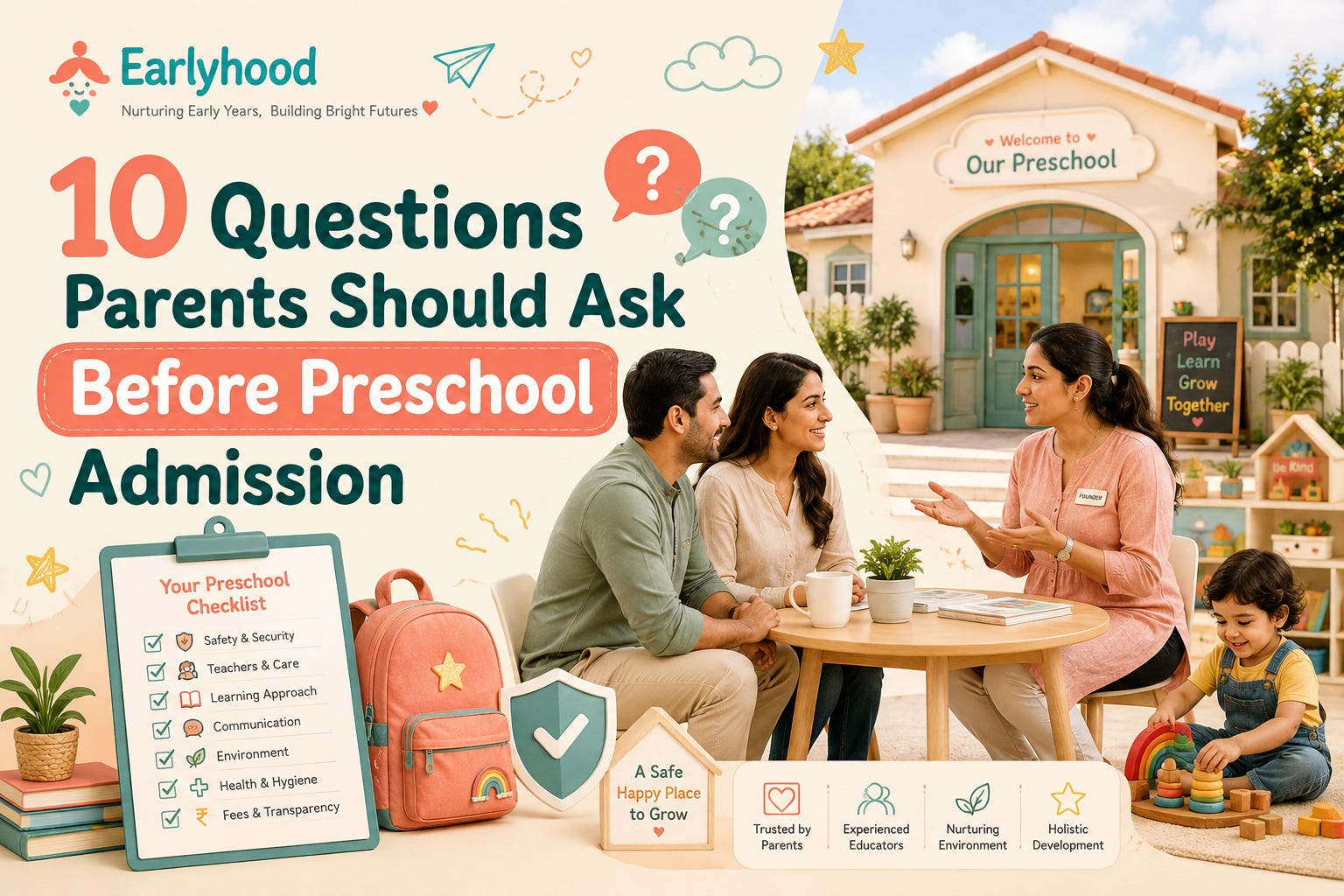
Preschool admission is not just about filling a form.
It is one of the first major decisions parents make for their child. A preschool becomes the child’s first learning space outside home. It shapes how the child feels about school, teachers, routines, friends, play, and learning.
Many parents visit a preschool and mostly ask about fees, timings, transport, and admission availability. These are important, but they are not enough.
Before choosing a preschool, parents should ask questions that reveal the school’s real approach to early childhood.
A good preschool should feel safe, warm, age-appropriate, and child-focused.
Here are 10 important questions every parent should ask before preschool admission.
1. What is your teacher-child ratio?
This is one of the most important questions.
Young children need attention, supervision, comfort, and help with routines. If one teacher is handling too many children, it becomes difficult to notice every child’s needs.
Ask how many children are in one class and how many teachers or assistant teachers are present.
A lower teacher-child ratio usually means better care, especially for younger age groups.
Also ask whether support staff are trained to handle small children kindly and safely.
2. How do you help children settle in?
Many children cry during the first few days of preschool. This is normal.
But how the preschool handles separation anxiety matters.
Ask:
Can parents stay for some time during the settling period?
Do you allow gradual transition?
How do teachers comfort crying children?
What happens if a child cries for many days?
A good preschool should not shame children for crying. It should have a gentle settling process that helps children feel safe.
3. What does a typical day look like?
Ask the preschool to explain the daily routine.
A balanced preschool day should include play, stories, rhymes, art, movement, snack time, outdoor play, group interaction, quiet time, and age-appropriate learning.
If the day is only filled with worksheets, writing, and sitting, it may not be ideal for early childhood.
Young children need movement and hands-on experiences. Learning should feel active and joyful, not stressful.
4. What curriculum or learning approach do you follow?
Many schools use words like Montessori, playway, experiential learning, activity-based learning, or integrated curriculum.
Do not get impressed only by labels.
Ask what those words mean in daily classroom practice.
For example:
How do children learn numbers?
How do you introduce language?
How much time is given to free play?
Do children work with hands-on materials?
How much writing is expected?
The answer should feel clear, practical, and age-appropriate.
5. How do you ensure child safety?
Safety should never be assumed.
Ask about:
Entry and exit rules
Visitor policy
Pick-up authorization
CCTV availability
Staff verification
Emergency procedures
First-aid readiness
Child-safe furniture
Washroom supervision
Transport safety, if applicable
Also observe the space yourself. Look at stairs, gates, corners, electrical points, furniture, toys, and outdoor play areas.
A preschool should be designed with young children in mind.
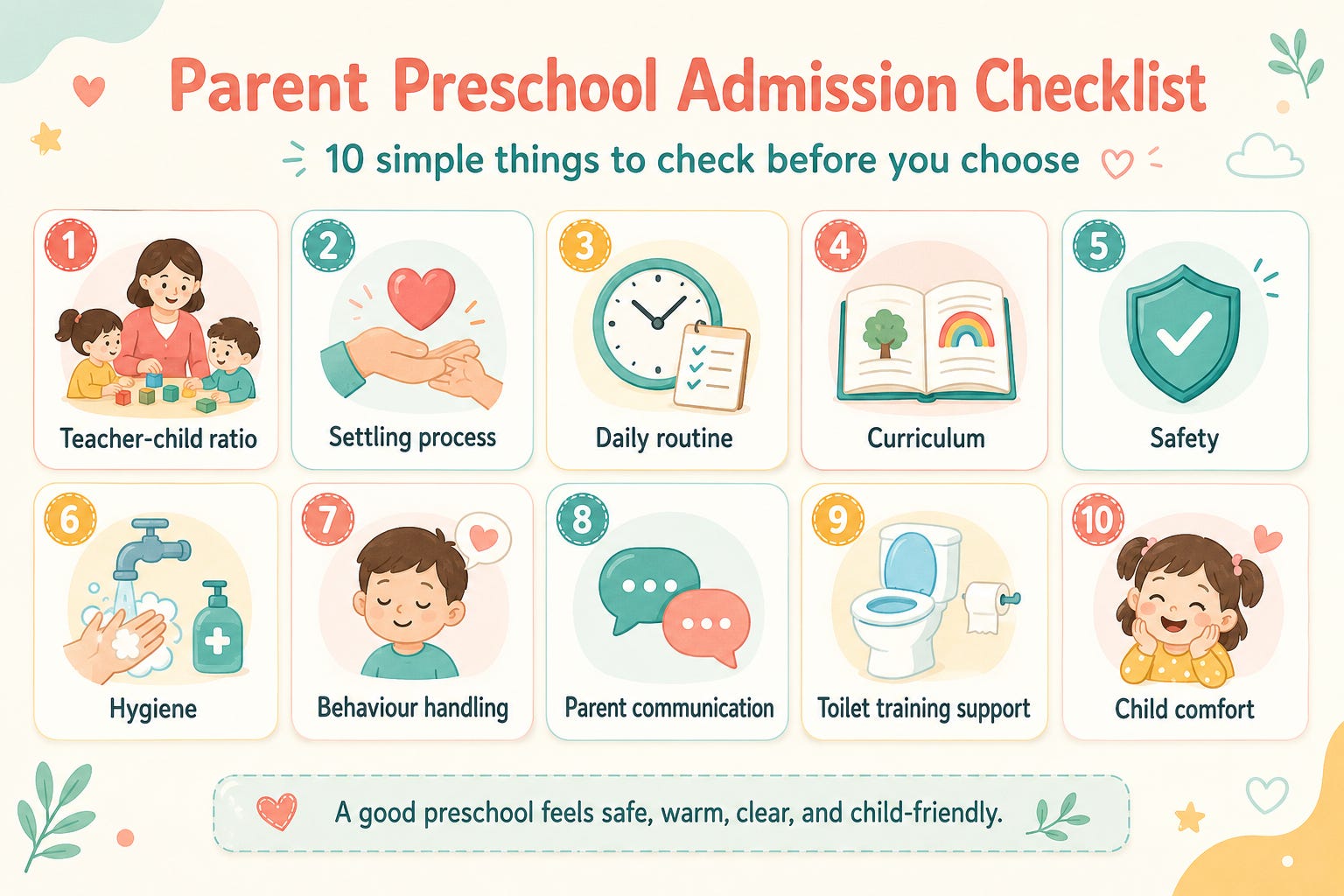
6. How do you manage hygiene and illness?
Young children touch everything, share toys, and need help with toilet routines. Hygiene is very important.
Ask:
How often are toys cleaned?
How are washrooms maintained?
What happens if a child falls sick at school?
Do you inform parents immediately?
How do you manage handwashing?
Are children encouraged to follow hygiene habits?
A clean preschool does not need to look fancy, but it should feel well-maintained and child-safe.
7. How do teachers handle tantrums, hitting, or biting?
Preschool children are still learning emotional control and social behaviour.
Ask how teachers handle difficult moments.
The answer should not be based on fear, punishment, or shaming.
A good preschool should guide children calmly, teach them words for feelings, redirect behaviour, and protect other children without labelling the child as “bad.”
This question tells you a lot about the emotional environment of the school.
8. How do you communicate with parents?
Parent communication should be clear and consistent.
Ask:
Will I get daily or weekly updates?
Do you share photos or activity notes?
How often are parent-teacher meetings held?
Can parents speak to teachers if there is a concern?
How do you update us about food, mood, sleep, toilet routines, and participation?
Preschool communication should not only be about academics. Parents should understand how the child is adjusting emotionally and socially.
9. Is toilet training compulsory?
Some preschools expect children to be toilet trained before admission. Others support children through the process.
Ask this clearly before admission.
If your child is still learning toilet habits, understand how the school manages accidents, changing clothes, washroom support, and communication with parents.
A preschool should handle this stage with patience and dignity.
Young children should not be embarrassed for normal developmental needs.
10. What makes your preschool right for my child?
This final question is important.
It allows the preschool owner or counsellor to explain their philosophy.
Listen carefully.
Do they talk only about facilities, fees, and academics?
Or do they talk about child comfort, safety, teachers, play, emotional growth, curiosity, and parent partnership?
The right preschool should understand that every child is different.
Some children are shy. Some are active. Some speak early. Some take time. Some adjust quickly. Some need more comfort.
A good preschool should be ready to support different children with warmth and patience.
What Parents Should Observe During the Visit
Questions are important, but observation is equally important.
Look at the children already present.
Do they seem comfortable?
Are teachers speaking kindly?
Is the classroom calm or chaotic?
Are children engaged?
Are toys and materials accessible?
Is the environment clean?
Do teachers notice children’s needs?
Does the space feel safe?
Sometimes, the feeling of the place tells you more than the brochure.
Earlyhood Tip
Do not choose a preschool only because it is popular.
Choose a preschool where your child can feel safe, respected, and ready to explore.
Before admission, ask questions slowly. Take notes. Visit more than one school if possible. Trust your observation.
A good preschool will welcome parent questions. It will not make you feel uncomfortable for asking about safety, teachers, curriculum, or child care.
Final Thought
Preschool is not just preparation for formal school.
It is the beginning of a child’s relationship with learning.
The right preschool can help a child build confidence, language, independence, social skills, routines, and curiosity.
So before admission, ask the right questions.
Because when parents ask better questions, they make better decisions.
And every child deserves a preschool where they feel safe, cared for, and happy to learn.
Join the Earlyhood Parent Community for trusted guidance on learning, parenting, health, preschool, activities, and storytime for children aged 0–8.