


Screens have become part of everyday family life.
Sometimes they help children watch rhymes, learn something new, or stay busy while parents finish work. But when screens become the easiest solution for every free moment, children may miss out on something very important: real play.
Young children need movement, imagination, touch, conversation, stories, creativity, and family connection. These things help them grow in ways screens cannot fully replace.
The good news is that screen-free activities do not need expensive toys or complicated planning. Many of the best activities can happen at home with simple objects, a little time, and a calm parent-child moment.
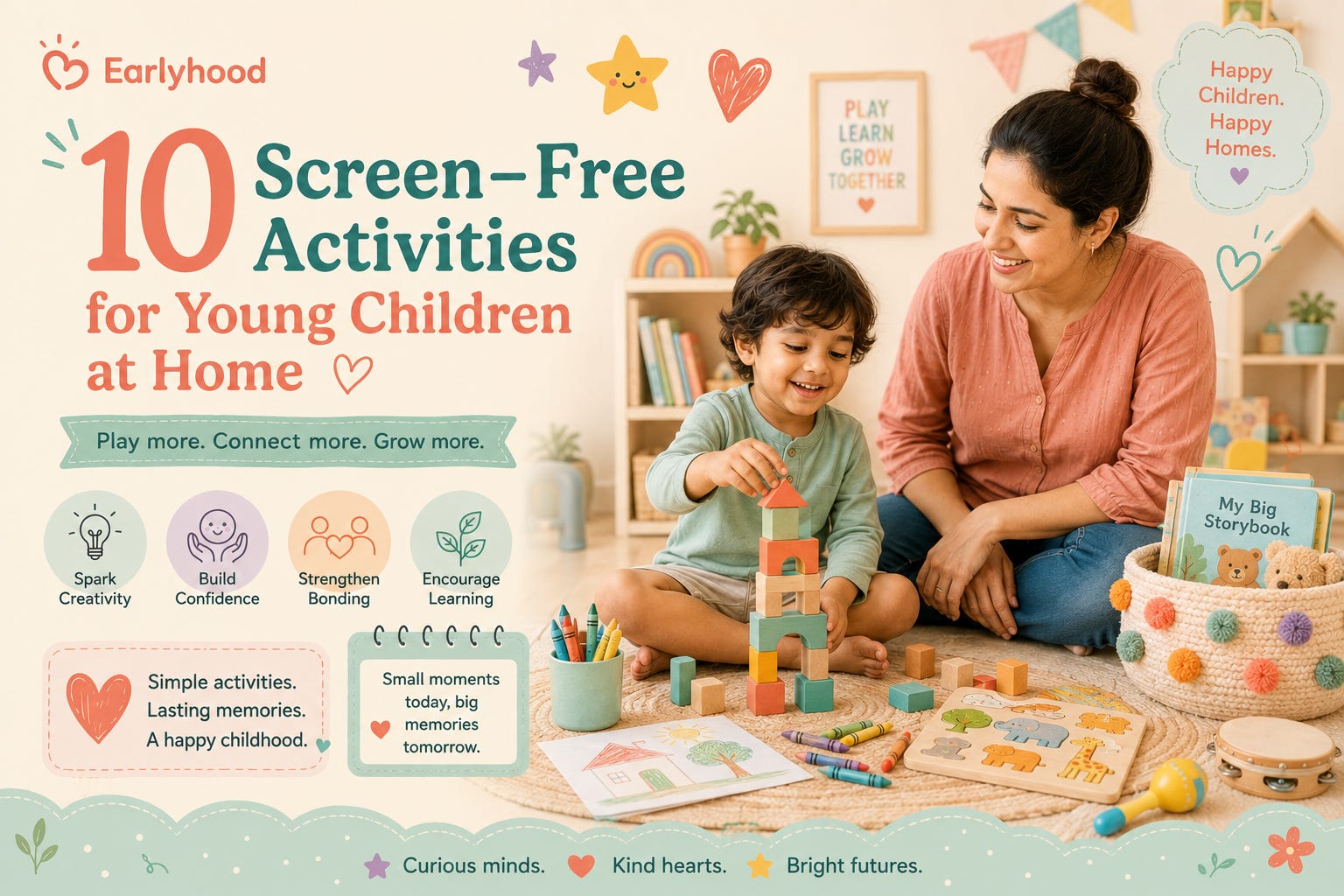
Here are 10 easy screen-free activities for children aged 2–8.
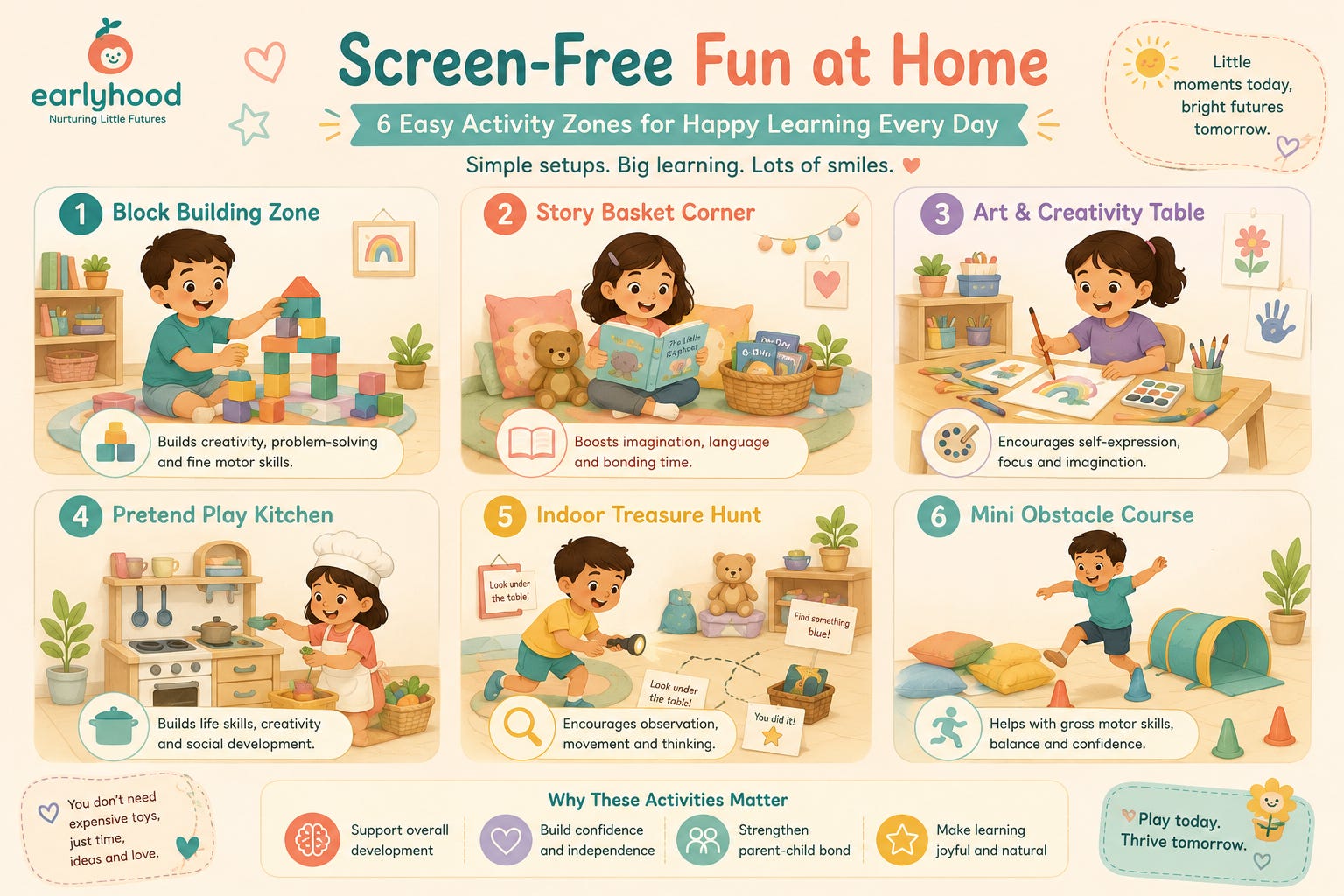
1. Build With Blocks or Boxes
Give your child blocks, cardboard boxes, plastic cups, cushions, or safe household containers.
Ask them to build a tower, house, bridge, shop, school, or city.
This activity helps with imagination, problem-solving, hand control, balance, and patience. If the tower falls, don’t rush to fix it. Let your child try again.
Parent prompt:
“What are we building today?”
2. Story Basket
Create a small basket with random objects like a spoon, toy animal, small car, ribbon, ball, cup, or soft toy.
Ask your child to pick three objects and make a story.
For example, a spoon, lion, and car can become: “The lion drove to the forest café to eat soup.”
This builds imagination, speech, vocabulary, memory, and confidence.
Parent prompt:
“What happened next?”
3. Indoor Treasure Hunt
Hide 5–8 simple objects around the room.
Give clues like:
“Find something red.”
“Find something soft.”
“Find something round.”
“Find something you use in the kitchen.”
This activity keeps children active and builds listening, observation, colour recognition, and problem-solving.
For older children, you can make clue cards.
4. Art Without Rules
Give your child paper, crayons, sketch pens, old magazines, glue, stickers, or safe craft materials.
Instead of asking them to draw something perfectly, let them create freely.
Children may draw lines, shapes, houses, animals, rainbows, or something imaginary. The final result does not need to look perfect.
Art supports fine motor skills, creativity, focus, emotional expression, and confidence.
Parent reminder:
Praise the effort, not the result.
Say:
“I love how you used so many colours.”
5. Pretend Play Corner
Pretend play is one of the most powerful activities for young children.
Set up a simple play corner:
Doctor clinic
Kitchen
Restaurant
School
Shop
Bus stop
Library
Home office
Use safe household items. A spoon can become a microphone. A towel can become a cape. A notebook can become a menu.
Pretend play helps children understand the world, use language, express emotions, and build social skills.
6. Music and Movement
Play simple songs and let your child dance, clap, jump, march, spin, or freeze.
You can also create your own movement game:
Jump like a frog
Walk like an elephant
Fly like a bird
Tiptoe like a cat
Freeze like a statue
This activity helps children release energy, improve body control, follow instructions, and enjoy rhythm.
It is especially useful when children are restless indoors.
7. Sorting and Matching Games
Use buttons, socks, spoons, toy cars, blocks, leaves, or bottle caps.
Ask your child to sort them by colour, size, shape, type, or use.
Examples:
Put all blue toys together.
Match socks by pair.
Sort big and small spoons.
Group animals and vehicles separately.
This activity builds early math, observation, focus, and logical thinking.
8. Kitchen Helper Activity
Children love being involved in real work.
Give them small, safe kitchen tasks like:
Washing vegetables
Mixing batter
Peeling banana
Arranging fruits
Rolling small dough balls
Sprinkling seeds
Placing idlis on a plate
Kitchen activities build responsibility, hand skills, food awareness, language, and family connection.
Keep it safe and simple. The goal is participation, not perfection.
9. Calm Reading Time
Choose one picture book or short story.
Read slowly. Point to pictures. Ask small questions.
“What do you see?”
“How is the child feeling?”
“What colour is the balloon?”
“What do you think will happen next?”
Reading time improves language, attention, imagination, emotional understanding, and bonding.
Even 10 minutes a day can become a beautiful family routine.
10. Make a Mini Obstacle Course
Use cushions, chairs, mats, tape, pillows, and soft toys to create a safe indoor obstacle path.
Ask your child to:
Crawl under a chair
Jump over a pillow
Walk on a tape line
Balance a soft toy
Touch the wall and return
Climb over cushions
This helps with movement, coordination, balance, listening, and confidence.
Always supervise and keep the setup safe.
How to Make Screen-Free Time Easier
Do not suddenly remove screens without offering something else.
Children need replacement activities.
Start small:
15 minutes of screen-free play daily
One screen-free evening per week
One story before bedtime
One weekend activity together
One family meal without screens
Keep materials visible and easy to access: books, blocks, crayons, puzzles, clay, balls, and pretend play items.
When activities are easy to start, children are more likely to choose them.
Earlyhood Tip
Children do not always need parents to entertain them fully.
They need space, simple materials, and a little encouragement.
You can begin the activity, play for a few minutes, and then let your child continue independently.
Say:
“I’ll sit with you for five minutes. Then you can build the rest.”
This slowly builds independent play.
Final Thought
Screen-free activities are not about making parenting harder.
They are about giving children more chances to move, imagine, speak, create, solve, and connect.
A child does not need a perfect activity setup. They need simple play, loving attention, and freedom to explore.
Start with one activity today.
A story basket, a tower, a pretend shop, a drawing page, or a small treasure hunt can become a meaningful childhood memory.
Join the Earlyhood Parent Community for trusted guidance on learning, parenting, health, preschool, activities, and storytime for children aged 0–8.