


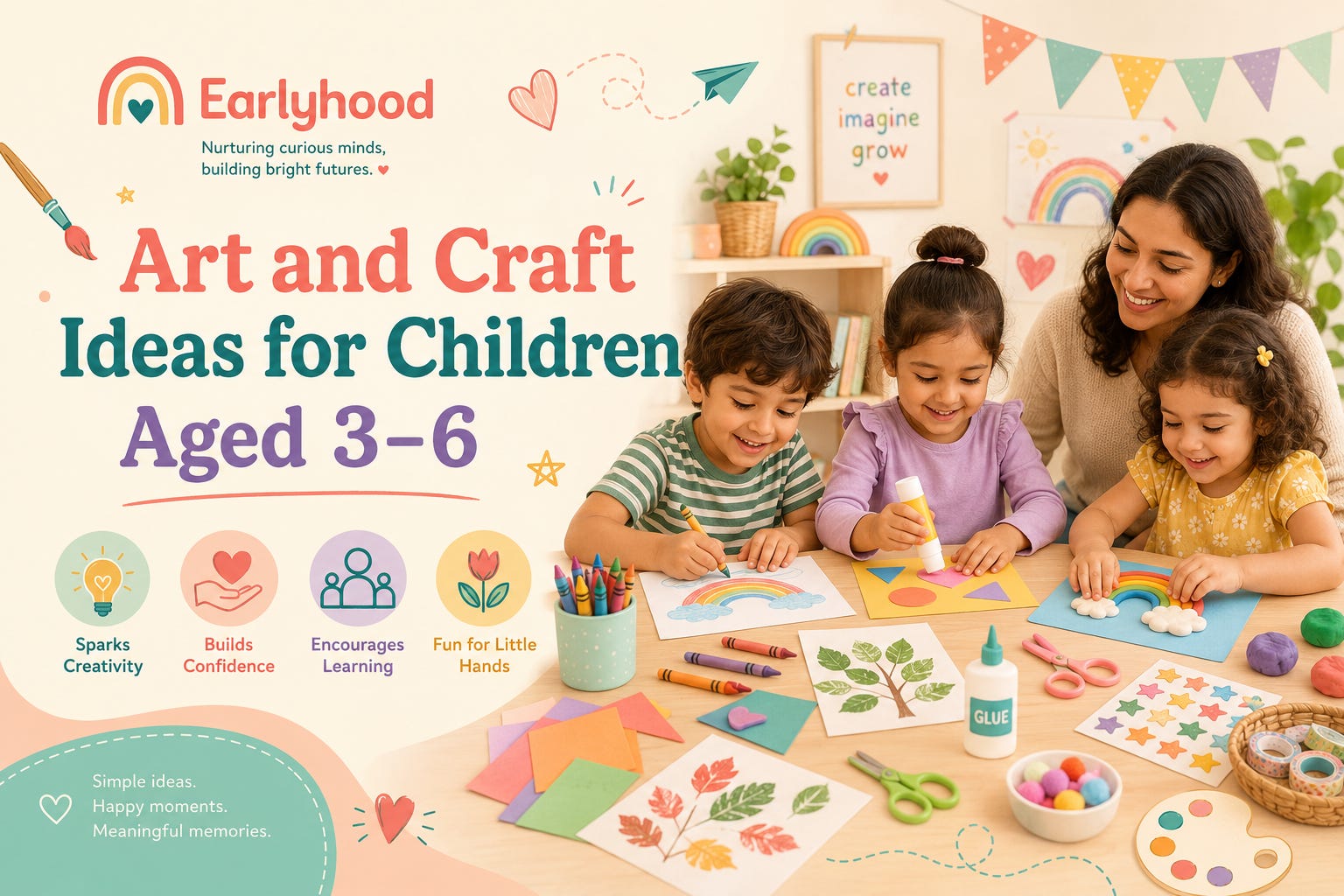
Art and craft are not only about making something beautiful.
For young children, art is a way to explore colours, shapes, textures, ideas, emotions, and imagination. A child may draw random lines, tear paper, mix colours, stick leaves, paint with fingers, or make a simple paper crown. To adults, it may look messy. But for the child, it is learning.
Children aged 3–6 do not need perfect craft outcomes. They need safe materials, freedom to explore, gentle guidance, and appreciation for effort.
The goal is not to create a Pinterest-perfect activity.
The goal is to let children create, try, make mistakes, and feel proud.
Why Art and Craft Matter
Art and craft support many areas of development.
When children hold crayons, squeeze glue, tear paper, roll clay, paint with fingers, or stick shapes, they are building fine motor skills. These small hand movements later support writing, self-care, eating, buttoning, and daily independence.
Art also helps children focus.
Even a 10-minute drawing activity can build attention and patience. Children learn to sit, choose colours, complete a small task, and enjoy the process.
Most importantly, art gives children confidence.
When a child says, “I made this,” they feel capable.
That feeling matters.
1. Free Drawing With Crayons
This is the simplest activity.
Give your child plain paper and crayons. Let them draw anything: lines, circles, people, animals, houses, rainbows, roads, or imaginary shapes.
Do not correct the drawing.
Avoid saying:
“That does not look like a dog.”
“The sun should be yellow.”
“Draw properly.”
“Colour inside the line.”
Instead, ask:
“Tell me about your drawing.”
“What is happening here?”
“Which colour did you use?”
“What should we add next?”
This helps children express ideas without fear.
2. Paper Tearing and Pasting
Paper tearing is excellent for finger strength.
Give your child old newspapers, colour paper, or magazine pages. Ask them to tear paper into small pieces and paste them on a sheet.
They can make:
Rainbow collage
Tree leaves
Fish scales
Flower petals
Clouds
Birthday card
Colour patch artwork
For younger children, keep the shapes simple. For older children, you can draw an outline and let them fill it with torn paper.
This activity builds hand strength, coordination, patience, and creativity.
3. Finger Painting
Finger painting is messy, but children love it.
Use child-safe washable colours. Put a small amount of paint on a plate and let the child use fingers to make dots, lines, flowers, clouds, animals, or abstract patterns.
You can also give prompts:
Make rain with your fingers.
Make flowers with fingerprints.
Make a colourful garden.
Make a happy monster.
Make a rainbow road.
Keep wipes, water, and an old cloth ready.
The goal is sensory exploration, not neatness.
4. Leaf Printing
Leaf printing is a beautiful nature-based craft.
Collect safe leaves from a garden or park. Apply paint on one side of the leaf and press it on paper.
Children can observe leaf shapes, lines, and patterns.
They can make:
Leaf garden
Butterfly wings
Tree artwork
Forest scene
Greeting card
Nature collage
This activity connects art with nature and observation.
You can ask:
“Which leaf is bigger?”
“Which one has more lines?”
“What shape does this leaf make?”
5. Clay or Dough Play
Clay play is one of the best activities for children aged 3–6.
Children can roll, squeeze, press, pinch, flatten, cut, and shape clay.
They can make:
Balls
Snakes
Fruits
Flowers
Animals
Cookies
Small bowls
Pretend food
Clay strengthens fingers and improves hand control.
For younger children, focus on squeezing and rolling. For older children, try simple shapes and pretend play.
Always supervise and use child-safe clay or homemade dough.
6. Shape Sticking Activity
Cut simple shapes from coloured paper: circles, squares, triangles, rectangles, stars, and hearts.
Ask your child to create something using the shapes.
A circle can become a face.
A triangle can become a roof.
A rectangle can become a bus.
A square can become a house.
A heart can become a flower petal.
This activity supports shape recognition, creativity, planning, and visual thinking.
Parents can help with cutting, while children choose and paste.
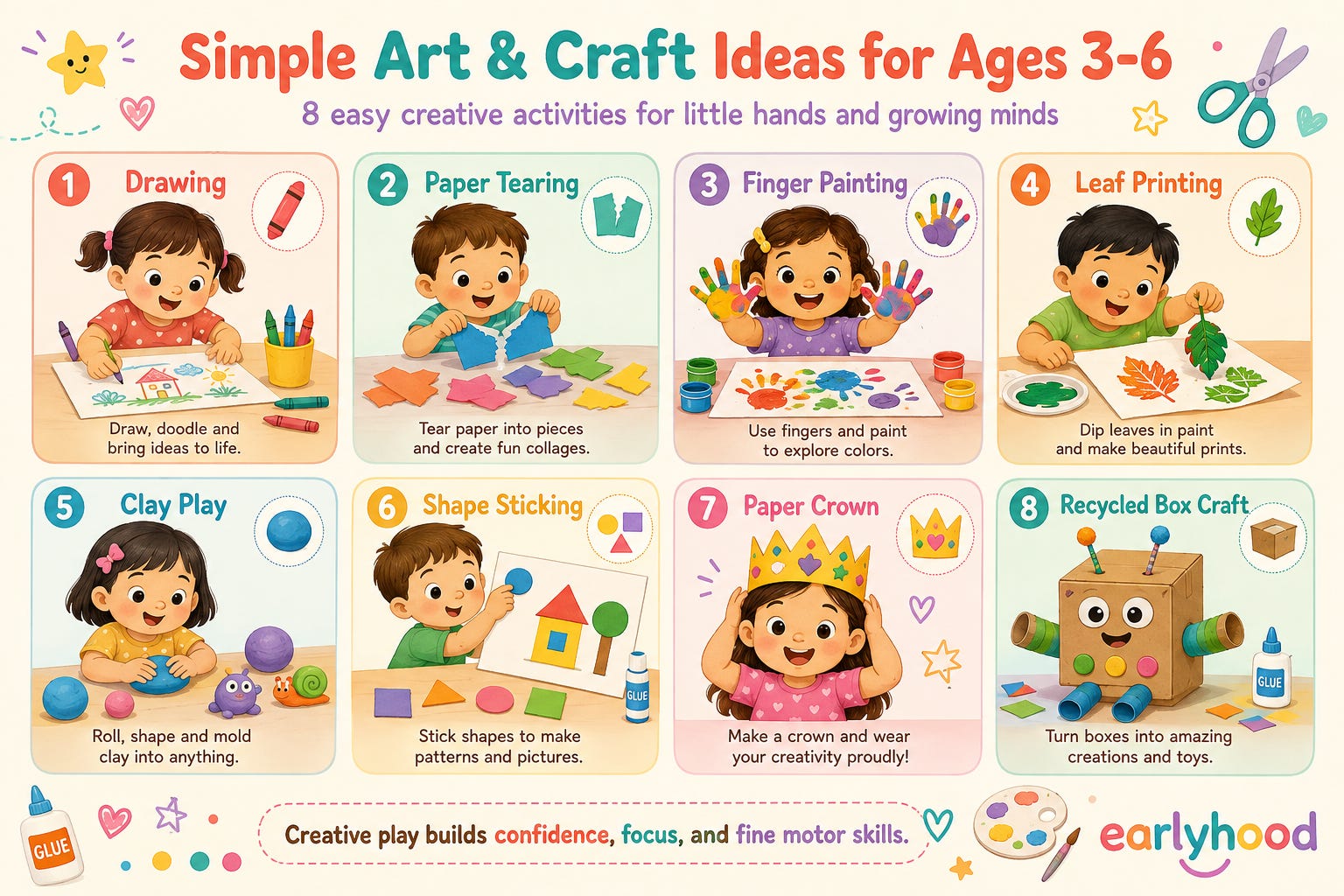
7. Make a Paper Crown
Children enjoy wearable crafts.
Cut a long strip of paper and let your child decorate it with crayons, stickers, stars, dots, flowers, or paper shapes.
Then join the ends to make a crown.
You can create themes:
Birthday crown
Animal crown
King or queen crown
Festival crown
Flower crown
Superhero crown
After making the crown, allow pretend play.
The craft becomes both creative and imaginative.
8. Cotton Ball Clouds
This is a soft and simple craft.
Draw clouds, sheep, snow, or a moon scene. Give your child cotton balls and let them paste them on the picture.
Children can make:
Cloudy sky
Rainy day
Sheep
Snowman
Moon and stars
Soft pillow picture
This activity introduces texture and builds hand coordination.
Use only a small amount of glue and supervise carefully.
9. Handprint and Footprint Art
Handprint art creates memories for parents and children.
Use washable paint and make prints of your child’s hand or foot on paper.
Then turn them into:
Tree
Fish
Butterfly
Flower
Sun
Bird
Elephant
Family card
Children enjoy seeing their own hand become part of the picture.
It also makes a beautiful keepsake.
10. Recycled Box Craft
Use safe empty boxes from home.
A small carton can become a house.
A cereal box can become a bus.
A tissue box can become a robot.
A delivery box can become a toy shop.
A shoebox can become a doll house.
Give your child crayons, paper, stickers, tape, and help them decorate.
This activity builds imagination, problem-solving, and creativity.
It also teaches children that useful things can be made from everyday materials.
11. Sticker Story Art
Give your child a few stickers and a blank paper.
Ask them to create a story around the stickers.
For example, if the stickers are animals, they can draw a forest around them. If the stickers are stars, they can make a night sky. If the sticker is a car, they can draw a road and houses.
Then ask:
“What is the story?”
“Where are they going?”
“Who is the main character?”
This combines art with language and storytelling.
12. Simple Greeting Cards
Children can make greeting cards for parents, grandparents, teachers, friends, or festivals.
Fold paper in half. Let the child decorate with drawings, stickers, handprints, or paper shapes.
You can write the message they say.
For example:
“I love you.”
“Happy birthday.”
“Thank you teacher.”
“Get well soon.”
“Happy festival.”
This teaches children that art can be used to express love, care, and gratitude.
How to Set Up an Art Corner at Home
You do not need a big space.
A small basket is enough.
Keep:
Crayons
Paper
Glue stick
Child-safe scissors for older children
Stickers
Clay
Colour paper
Old magazines
Washable paint
Apron or old T-shirt
Wipes or cloth
Keep materials easy to access, but supervise items like scissors, glue, small objects, and paint.
Use a mat or old newspaper to reduce cleanup stress.
What Parents Should Remember
Children’s art will not always look neat.
That is okay.
Do not focus only on the final product. Focus on the process.
Instead of saying only “beautiful,” say:
“You worked hard on this.”
“I like how you mixed colours.”
“You used many shapes.”
“You made your own idea.”
“Tell me about this part.”
This builds confidence and language.
Earlyhood Tip
Use this simple art rule:
Less correction. More conversation.
When children feel safe to create freely, they become more confident and expressive.
Art is not about perfection. It is about exploration.
Final Thought
Art and craft can become one of the most joyful parts of childhood.
A simple crayon drawing, paper collage, clay animal, leaf print, or handmade card can teach children creativity, patience, hand control, problem-solving, and self-expression.
Parents do not need expensive kits or perfect setups.
They only need simple materials, a little time, and a willingness to let children explore.
Because every small artwork tells a child:
“My ideas matter.”
And that confidence is more valuable than a perfect picture.
Join the Earlyhood Parent Community for trusted guidance on learning, parenting, health, preschool, activities, and storytime for children aged 0–8.