



Sundays can become very busy.
There are pending chores, grocery runs, house cleaning, family visits, school preparation, office planning, screen time, and sometimes complete tiredness from the week.
But for children, Sunday can also become a special family memory.
Children do not always need expensive outings or big entertainment plans. Many times, they remember small moments: cooking together, playing a board game, reading a story, watering plants, making a card, going for a walk, or having breakfast as a family.
Family bonding is not about doing something perfect.
It is about being present.
For children aged 0–8, simple Sunday rituals can build emotional security, confidence, communication, family connection, and happiness.
Here are practical family bonding activities parents can try on Sundays.
1. Sunday Breakfast Together
Start the day with a slow family breakfast.
It does not need to be fancy. It can be idli, dosa, poha, paratha, fruits, eggs, upma, sandwiches, or anything your family enjoys.
The important part is eating together without rushing.
Let your child help in small ways:
Place spoons
Keep plates
Wash fruits
Mix batter
Choose chutney
Serve water
Fold napkins
During breakfast, ask simple questions:
“What was your favourite moment this week?”
“What should we do today?”
“What made you laugh?”
“What do you want to learn?”
This makes breakfast more than food. It becomes conversation.
2. Family Storytime
Choose one book and read it together.
For younger children, use picture books. For older children, use short stories, folk tales, animal stories, moral stories, or family stories.
You can also tell stories from your own childhood.
Children love hearing:
“When I was small…”
“When your grandmother was young…”
“When we first brought you home…”
“When papa went to school…”
Family stories help children feel connected to their roots.
After the story, ask:
“What did you like?”
“Who was your favourite character?”
“What would you do?”
“Can we make a new ending?”
Storytime builds language, imagination, listening, and parent-child bonding.
3. Cook Something Simple Together
Cooking together is one of the best bonding activities.
Children enjoy real work when parents make it safe and simple.
Try:
Fruit bowl
Lemon water
Mini sandwiches
Dosa topping
Vegetable salad
Chapati rolling
Curd rice mixing
Sprout chaat
Homemade pizza toast
Simple ladoo shaping
Give age-appropriate tasks.
A 3-year-old can wash vegetables or mix.
A 5-year-old can arrange fruits.
A 7-year-old can help measure, spread, or decorate.
Cooking builds responsibility, food awareness, hand skills, patience, and confidence.
The kitchen may become messy, but the memory is worth it.
4. Go for a Nature Walk
A Sunday walk does not need a big park.
It can happen in your apartment, lane, terrace, garden, nearby park, or quiet walking area.
Make it a discovery walk.
Ask your child to find:
Three leaves
One bird
Something yellow
A round stone
A tall tree
A flower
An ant trail
A cloud shape
You can also carry a small notebook and draw what you saw after coming home.
Nature walks help children observe, ask questions, move their body, and slow down.
Parents also get a break from screens and indoor routines.
5. Make a Family Art Project
Instead of giving art only to the child, make it a family activity.
Try:
Family handprint poster
Sunday memory card
Gratitude jar
Family tree drawing
Photo collage
Festival decoration
Paper flowers
Thank-you cards
Vision board for the week
“Things we love” poster
Let everyone contribute.
The final artwork does not need to look perfect. It only needs to represent your family’s time together.
You can write the date on it and save it.
Over time, these small projects become beautiful memories.
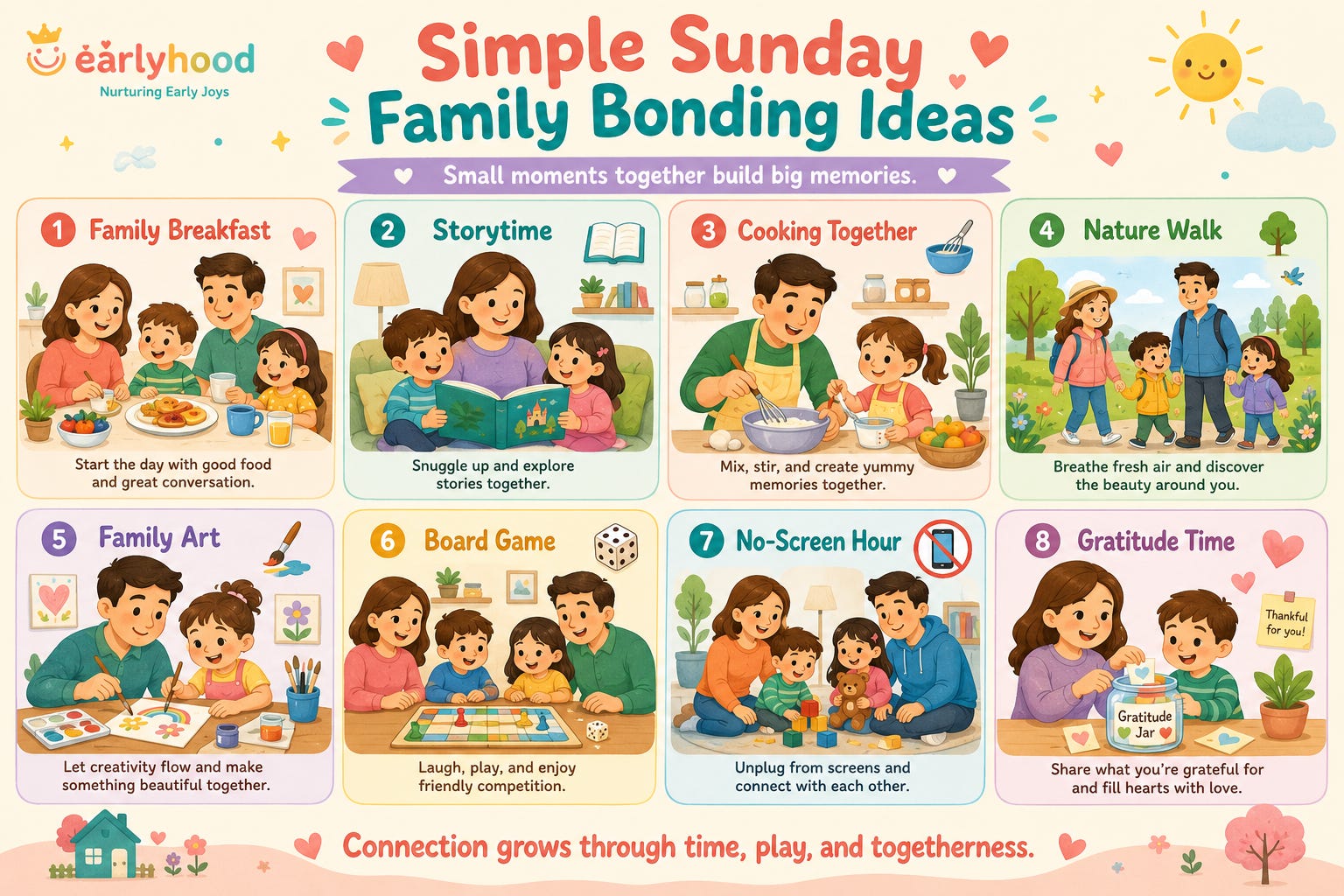
6. Play a Board Game or Floor Game
Games teach children turn-taking, patience, rules, winning, losing, and laughter.
Choose simple games based on age:
Ludo
Snakes and ladders
Memory cards
Dominoes
Puzzles
Building blocks
Car race
Treasure hunt
Pretend shop
Sorting games
Indoor bowling
Ball passing
For younger children, keep rules flexible.
For older children, slowly teach rules and fair play.
The goal is not winning. The goal is playing together.
Parents can model:
“Your turn.”
“I lost, but I enjoyed playing.”
“Let’s try again.”
“Good move.”
“We clap for everyone.”
7. Create a No-Screen Hour
Choose one hour on Sunday where the whole family keeps screens away.
Not only the child — parents too.
Children accept screen rules better when adults join.
During the no-screen hour, you can:
Read
Draw
Cook
Play blocks
Go for a walk
Talk
Dance
Clean together
Listen to music
Play pretend games
Call it something positive:
Family Hour
Sunday Play Hour
No-Phone Fun Time
Together Time
Screen-Free Sunday Hour
Keep it light, not strict.
The idea is to create connection, not punishment.
8. Dance or Music Time
Music can quickly change the mood at home.
Play your child’s favourite song, a devotional song, folk song, rhymes, old family favourite, or simple instrumental music.
Dance together.
Try:
Freeze dance
Animal dance
Slow-fast dance
Clap rhythm
Family singing
Musical statue
Action songs
Dance with scarves
Children love seeing parents participate.
Even 15 minutes of family music time can bring laughter and release stress.
9. Do One Household Task Together
Children like being useful.
Give them small responsibilities on Sunday.
They can help:
Fold small towels
Water plants
Sort socks
Keep toys back
Arrange books
Clean table with cloth
Put clothes in basket
Pack school bag
Organise crayons
Set dinner plates
Do not expect perfection.
Say:
“Thank you for helping.”
“You are part of the family team.”
“We do this together.”
This builds responsibility, independence, and belonging.
10. Sunday Reflection and Gratitude
At the end of the day, spend five quiet minutes together.
Ask everyone to share:
One thing I enjoyed today
One thing I am thankful for
One thing I want to do next week
One person I want to say thank you to
One thing that made me smile
Young children may give simple answers.
That is okay.
Gratitude and reflection help children notice positive moments. It also gives parents a gentle way to understand the child’s feelings.
You can even keep a family gratitude jar. Every Sunday, add one small note.
Simple Sunday Plan for Families
A Sunday bonding day does not need to be full.
Here is a simple plan:
Morning: Family breakfast
Late morning: Nature walk or outdoor play
Afternoon: Rest and storytime
Evening: Art, game, cooking, or music
Night: Gratitude and bedtime story
Do not pack too many activities.
Children often enjoy one or two good moments more than a full day of rushed plans.
What If Parents Are Tired?
Parents are human.
Some Sundays are low-energy days. You may not feel like going out, cooking, or planning activities.
That is okay.
Try low-effort bonding:
Read one book
Cuddle and talk
Draw together
Watch clouds from balcony
Sort toys together
Listen to music
Make a simple snack
Take a short walk
Tell one childhood story
Even 15 minutes of full attention can mean a lot to a child.
Family bonding is not about doing more. It is about being emotionally available.
Earlyhood Tip
Create one fixed Sunday ritual.
It can be Sunday breakfast, Sunday storytime, Sunday walk, Sunday art, or Sunday gratitude.
When repeated weekly, a small ritual becomes a family tradition.
Children feel secure when they know, “This is our special family time.”

Final Thought
Sundays do not need to be perfect.
They only need a few moments of connection.
A shared breakfast.
A story on the sofa.
A walk under trees.
A messy art project.
A silly dance.
A simple board game.
A small thank-you note before bed.
These are the moments children carry with them.
Family bonding is built through small, repeated acts of love.
So this Sunday, choose one simple activity.
Be present. Laugh a little. Listen more. Play together.
Because childhood memories are often made in ordinary family moments.
Join the Earlyhood Parent Community for trusted guidance on learning, parenting, health, preschool, activities, and storytime for children aged 0–8.