



Some children enter a room and immediately start talking.
Some children hide behind a parent, avoid eye contact, take time to answer, or refuse to join group activities.
Parents often worry when their child is shy.
They may think:
“Why is my child not mixing?”
“Will my child struggle in school?”
“Should I push more?”
“Is my child underconfident?”
“Why does my child talk at home but stay silent outside?”
Shyness is not a weakness.
Many shy children are thoughtful, observant, sensitive, careful, and deeply aware of their surroundings. They may simply need more time to feel safe before they participate.
The goal is not to change your child’s personality. The goal is to help your child feel confident while still being themselves.
Understand Shyness First
A shy child may not be refusing people.
They may be feeling unsure.
New places, loud groups, unfamiliar adults, birthday parties, school events, stage performances, or meeting relatives can feel overwhelming for some children.
A shy child may need time to observe before joining.
This does not mean the child is rude, weak, or badly behaved. It means the child’s comfort grows slowly.
Instead of saying, “Don’t be shy,” try to understand what the child is feeling.
You can say:
“It is okay to take time.”
“You can watch first.”
“I am here with you.”
“You can say hello when you feel ready.”
These lines help the child feel accepted.
Do Not Label the Child
Avoid saying in front of others:
“She is very shy.”
“He never talks.”
“She is scared of everyone.”
“He is not social.”
“My child is always like this.”
Labels can become a child’s identity.
When children hear adults describe them as shy again and again, they may start believing, “I am someone who cannot talk.”
Instead, use supportive language.
Say:
“She takes a little time to warm up.”
“He observes first and then joins.”
“She will answer when she is ready.”
“He is getting comfortable.”
This protects the child’s confidence.
Start With Small Social Steps
Confidence grows through small successful experiences.
Do not push a shy child directly into big situations like stage performance, crowded parties, or speaking in front of many people.
Start small.
Try:
Waving goodbye to one neighbour
Saying thank you to a shopkeeper
Ordering one item with parent support
Playing with one familiar child
Answering one simple question
Saying hello to a teacher
Choosing a book at the library
Joining a small activity group
Each small step builds courage.
Praise effort, not perfection.
Say:
“You said hello today. That was brave.”
“You tried joining the game.”
“You answered softly, but you answered.”
“You took one step closer today.”
Confidence grows when the child feels progress.
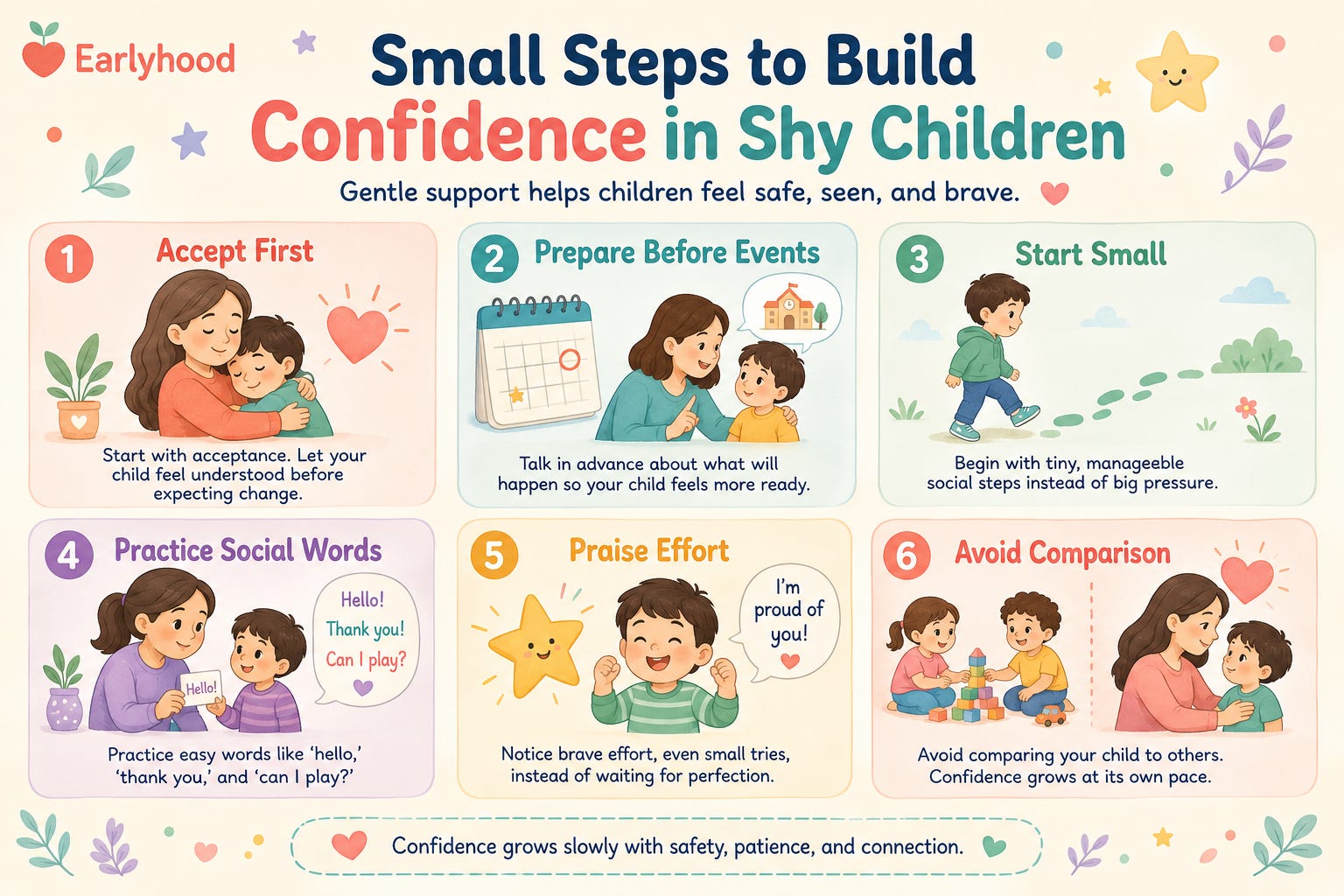
Prepare Before Social Situations
Shy children do better when they know what to expect.
Before going to a party, school event, class, or new place, prepare the child gently.
Say:
“We are going to Aarav’s birthday.”
“There will be music and children.”
“You can stay near me first.”
“You do not have to talk immediately.”
“After some time, you can play if you want.”
You can also role-play at home.
Practice:
How to say hello
How to ask for a toy
How to say “Can I play?”
How to say “No, thank you”
How to answer name and age
How to ask for help
Practice makes real situations less scary.
Let the Child Warm Up Slowly
Some children need 10 minutes. Some need 30 minutes. Some need several visits before they feel comfortable.
Give them time.
At a playdate, don’t force your child to immediately join. Let them watch. Sit nearby. Talk softly. Offer one small step.
You can say:
“Would you like to sit near the blocks?”
“Should we watch the children play first?”
“Do you want me to come with you?”
“You can start by giving the ball.”
Slow participation is still participation.
Respecting the child’s pace builds trust.
Build Confidence at Home First
A child who feels capable at home slowly becomes more confident outside.
Give your child small responsibilities:
Keep books back
Choose clothes
Help set the table
Water plants
Feed a pet with supervision
Put toys in baskets
Help pack school bag
Serve snacks to family
Tell one story at bedtime
When children feel useful, they feel confident.
Also allow your child to make choices.
Ask:
“Do you want the red cup or blue cup?”
“Which story should we read?”
“Which T-shirt will you wear?”
“Should we draw or build blocks?”
Choice builds decision-making and self-belief.
Encourage Speaking Without Forcing
Some shy children talk a lot at home but become quiet outside.
Do not force them to perform.
Avoid saying:
“Say something.”
“Why are you quiet?”
“Speak loudly.”
“Everyone is watching.”
“Don’t embarrass me.”
These lines can increase anxiety.
Instead, support gently.
If someone asks your child a question, give them time. Do not answer immediately unless the child looks very uncomfortable.
You can say:
“You can tell aunty your name.”
“Take your time.”
“You can whisper to me first.”
“Would you like to show your drawing instead?”
Over time, the child learns that speaking is safe.
Create Safe Social Practice
Confidence grows when children get regular, low-pressure social exposure.
Try:
Small playdates
Story sessions
Art classes
Park visits
Parent-child group activities
Library visits
Music or movement classes
Family gatherings with familiar people
Start with settings that are not too loud or crowded.
For shy children, one or two kind friends are better than a large group.
A child does not need to become the most talkative person in the room. They only need to feel comfortable connecting in their own way.
Praise Courage, Not Personality Change
Do not praise only when the child becomes outgoing.
Praise small brave actions.
Say:
“You tried something new.”
“You joined for five minutes.”
“You asked for help.”
“You smiled at your teacher.”
“You played with one child today.”
“You stayed calm in a new place.”
This teaches the child that confidence is about trying, not becoming someone else.
Avoid Comparison
Comparison can hurt shy children deeply.
Avoid saying:
“Look at your cousin, she talks so well.”
“Other children are dancing, why not you?”
“Your friend is not scared.”
“Everyone is playing except you.”
Comparison creates shame.
Instead, focus on your child’s journey.
Say:
“You are learning slowly.”
“You took more time today, and that is okay.”
“We will try again next time.”
“I am proud that you came with me.”
Children grow better with encouragement than pressure.
When Should Parents Seek Support?
Most shyness improves with time, safety, and practice.
But parents may consider speaking to a pediatrician, child psychologist, or early childhood expert if the child’s fear strongly affects daily life.
For example:
The child avoids all social situations
The child is extremely distressed in school
The child refuses to speak outside home for a long time
The child has frequent panic-like reactions
The child cannot separate from parents at all
The child’s confidence is reducing over time
Getting support does not mean something is wrong. It simply helps parents understand the child better.
Earlyhood Tip
Use this simple confidence formula:
Accept first. Prepare gently. Practice small. Praise effort. Repeat calmly.
Shy children do not need pushing.
They need safe chances to try.
Final Thought
Confidence does not mean being loud.
Confidence means feeling safe enough to try.
A shy child can still be confident. A quiet child can still be strong. A child who observes first can still become socially comfortable.
Parents do not need to remove shyness completely.
They need to build courage gently.
With patience, preparation, small steps, and loving support, shy children can learn to speak, participate, make friends, and explore the world at their own pace.
Because every child deserves to feel confident — without being forced to become someone else.
Join the Earlyhood Parent Community for trusted guidance on learning, parenting, health, preschool, activities, and storytime for children aged 0–8.