


Many parents worry when their child cannot sit in one place.
A child may leave toys unfinished, run away during writing, avoid storytime, jump from one activity to another, or get distracted easily. Parents may think:
“Why can’t my child focus?”
“Is my child careless?”
“Should I make them sit longer?”
“Why does my child listen only for a few minutes?”
“How can I improve attention at home?”
The first thing parents should understand is this: young children are not designed to focus like adults.
A 3-year-old, 4-year-old, or 5-year-old will naturally move, explore, touch, ask, switch, and get distracted. Attention grows with age, practice, interest, routine, and emotional comfort.
The goal is not to force long sitting.
The goal is to slowly build the child’s ability to stay with one activity, listen, complete small tasks, and return attention gently.
Focus Is a Skill, Not a Character Trait
When a child cannot focus, it does not mean the child is lazy or naughty.
Focus is a developing skill.
Children learn attention through repeated small experiences:
Listening to a story
Building blocks
Finishing a puzzle
Sorting colours
Helping in the kitchen
Drawing for a few minutes
Playing memory games
Following two-step instructions
Waiting for a turn
Completing a simple routine
Every small activity builds the attention muscle.
Parents should avoid saying:
“You never focus.”
“You are careless.”
“You don’t listen.”
“You are always distracted.”
These labels can reduce confidence.
Instead, say:
“Let’s try one small task.”
“Look here for a moment.”
“First finish this, then we play.”
“You are learning to focus.”
“Let’s do it together.”
Start With Short Activities
Do not expect young children to sit for 30–40 minutes.
Start with short, clear activities.
For a 3-year-old, even 5 minutes of focused play is good.
For a 4-year-old, 8–10 minutes can be a good start.
For a 5–6-year-old, 10–15 minutes may be possible depending on interest.
Begin with activities your child enjoys.
Try:
Puzzle
Blocks
Colour sorting
Picture book
Clay play
Bead threading
Shape matching
Drawing
Sticker activity
Pretend play setup
Once the child can stay with a favourite activity, slowly increase the time.
Focus grows better through success, not struggle.
Reduce Distractions Around the Child
Children get distracted easily when too many things are around them.
If the child is doing a puzzle, keep only the puzzle on the table.
If the child is colouring, keep only crayons and paper.
If the child is reading, keep toys, TV, mobile phone, and loud sounds away.
A clean, simple space helps attention.
You do not need a special study room. A small corner is enough.
Try this setup:
One mat or table
One activity at a time
Limited toys
No screen in background
Good light
Parent nearby
Clear start and finish
Too many choices can make children jump from one thing to another. Fewer choices help them stay longer.
Use “First, Then” Language
Children focus better when they understand the order.
Use simple “first, then” lines:
“First finish the puzzle, then we play ball.”
“First keep blocks back, then storytime.”
“First brush teeth, then bedtime story.”
“First colour this flower, then choose stickers.”
“First two pages, then snack.”
This helps children know what is expected.
It also reduces arguments because the child can see the next step.
Keep the task small. Do not say, “First complete all homework,” if the child is already tired. Break it into smaller parts.
Choose Hands-On Learning
Young children focus better when their hands are involved.
Instead of only worksheets, use hands-on activities.
For example:
Use blocks for counting
Use beads for patterns
Use clay for shapes
Use picture cards for matching
Use spoons for sorting
Use bottle caps for colours
Use toys for storytelling
Use household objects for size comparison
Hands-on learning keeps the child engaged because they can touch, move, arrange, and explore.
A child may not sit for writing, but they may focus longer while building a tower or sorting buttons.
That is still learning.
Build Focus Through Play
Play is one of the best ways to build attention.
Try these focus-building games:
Memory tray: Keep 5 objects on a tray. Let the child look, cover it, remove one object, and ask what is missing.
Puzzle time: Start with simple puzzles and slowly increase difficulty.
Simon Says: Helps listening and self-control.
Treasure hunt: Give clues like “Find something red” or “Find something round.”
Building challenge: Ask the child to build a tall tower, bridge, house, or road.
Sorting game: Sort buttons, blocks, spoons, leaves, or toys by colour, shape, or size.
Story sequencing: Show picture cards and ask what happened first, next, and last.
These games feel fun, but they quietly build attention, memory, listening, and thinking.
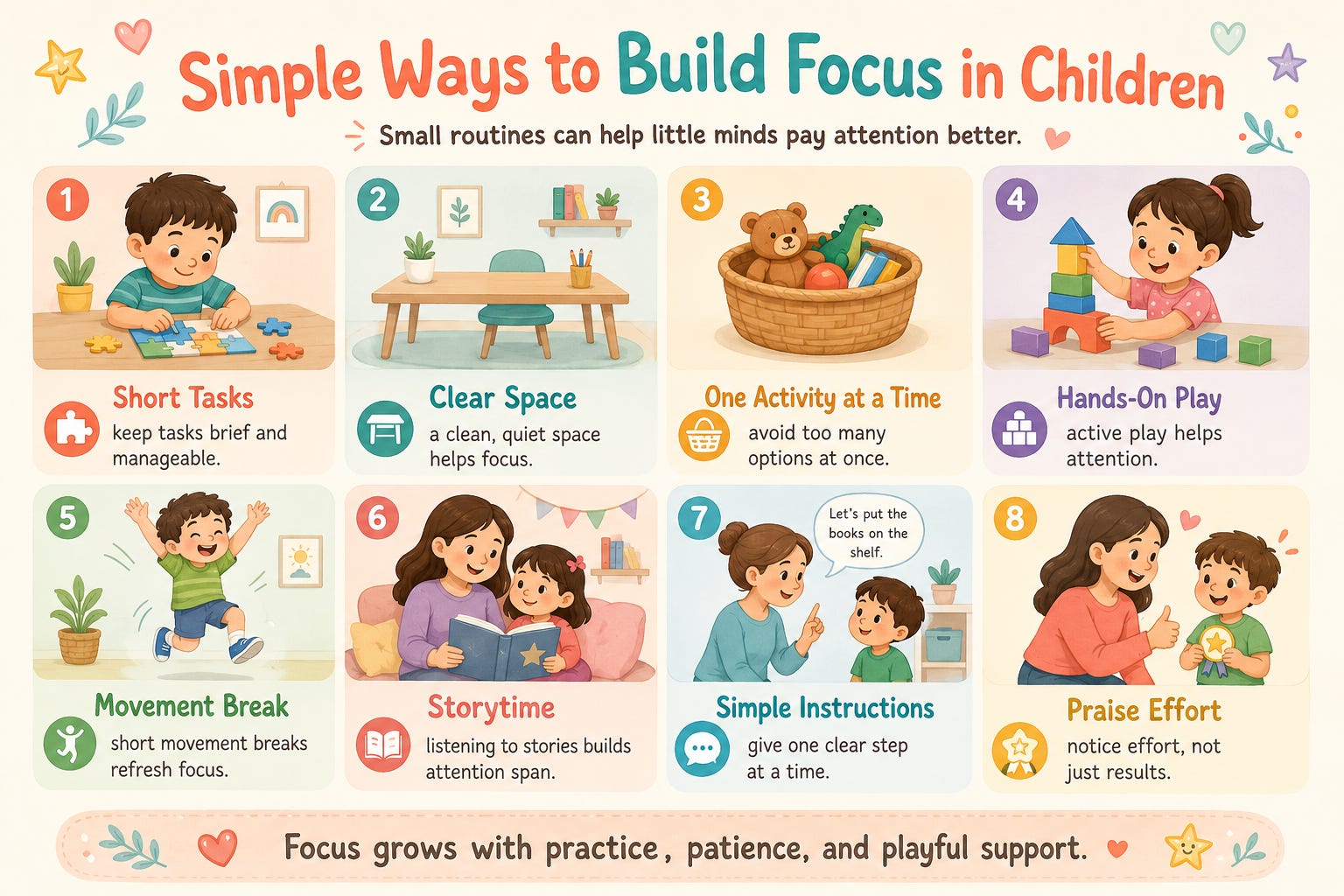
Read One Short Book Daily
Storytime can improve attention slowly.
Choose short picture books. Sit close to your child. Point to pictures. Use expression. Ask simple questions.
Do not force the child to sit through a long story at first.
Start with 3–5 minutes.
Say:
“Let’s read one small story.”
“Can you find the cat?”
“What is the boy doing?”
“What do you think will happen?”
“Let’s turn the page.”
Reading builds listening attention, language, imagination, and patience.
Daily storytime is one of the simplest focus-building habits at home.
Give Movement Before Sitting Tasks
Some children cannot focus because their body needs movement first.
Before asking your child to sit for drawing, reading, or writing, give a small movement break.
Try:
Jump 10 times
Run to the door and back
Do animal walks
Dance for one song
Stretch arms
Throw and catch a soft ball
Walk like a bear
Hop like a frog
Balance on one line
After movement, the child may be calmer and more ready to sit.
Movement is not the enemy of focus. For many children, movement helps focus.
Keep Instructions Simple
Long instructions confuse young children.
Instead of saying:
“Go to your room, take your book, bring your pencil box, sit properly, finish your work, and don’t make a mess.”
Say one or two steps:
“Bring your book.”
“Now sit here.”
“Open page one.”
“Colour the apple.”
“Put crayons back.”
Children focus better when the instruction is clear.
For younger children, use gestures also. Point, show, demonstrate, and then ask them to try.
Use Routine to Build Attention
Children focus better when their day has predictable routines.
For example:
Breakfast
Play
Outdoor time
Rest
Story
Activity
Dinner
Bath
Bedtime
When the child knows what comes next, the mind feels safer and calmer.
Create a small daily learning rhythm:
10 minutes story
10 minutes hands-on activity
10 minutes drawing or puzzle
Outdoor play
Free play
Do not make the routine too strict. Keep it simple and repeatable.
Avoid Overloading the Child
Sometimes parents give too many classes, worksheets, activities, toys, and instructions.
A tired child cannot focus well.
Watch for signs of overload:
Frequent crying
Avoiding activities
Restlessness
Anger
Sleepiness
Refusing simple tasks
Throwing materials
Asking for screens constantly
A child’s brain needs active play, rest, sleep, food, connection, and free time.
Focus improves when the child’s day is balanced.
Praise Effort and Completion
When your child stays with an activity, notice it.
Say:
“You completed the puzzle.”
“You sat and listened to the full story.”
“You kept trying.”
“You finished colouring the flower.”
“You focused for a long time today.”
“You came back and completed it.”
Praise specific behaviour, not only results.
This helps the child understand what focus feels like.
What Parents Should Avoid
Avoid these common mistakes:
Forcing long sitting
Using screens as the main attention tool
Giving too many toys at once
Expecting adult-like focus
Calling the child lazy
Comparing with other children
Starting difficult tasks when the child is tired
Skipping outdoor play
Turning every activity into study
Correcting every mistake
Young children focus better when learning feels safe and enjoyable.
When Should Parents Seek Guidance?
Some distraction is normal in young children.
But parents may speak to a pediatrician, child psychologist, occupational therapist, or early childhood expert if the child’s attention difficulty strongly affects daily life.
For example:
The child cannot stay with any activity even briefly
The child does not respond to simple instructions
The child is extremely restless all day
The child struggles badly in preschool
The child cannot complete even age-appropriate play tasks
The child seems unusually impulsive or distressed
Parents feel worried for a long time
Seeking support does not mean something is wrong. It helps parents understand the child’s needs better.
Earlyhood Tip
Use this simple focus formula:
Short task. Clear space. One instruction. Movement break. Gentle praise. Repeat daily.
Focus grows slowly.
Do not push for long attention suddenly. Build it step by step.
Final Thought
Focus is not built through pressure.
It grows through small daily practice.
A child learns attention while listening to a story, building blocks, solving a puzzle, sorting colours, helping in the kitchen, playing turn-taking games, or completing a small routine.
Parents do not need to force children to sit like adults.
They need to create the right environment: simple tasks, fewer distractions, enough movement, warm guidance, and patient repetition.
Because every child can learn to focus better when learning feels calm, playful, and safe.
Join the Earlyhood Parent Community for trusted guidance on learning, parenting, health, preschool, activities, and storytime for children aged 0–8.