



Many parents want to reduce screen time, but they do not know where to start.
Children ask for cartoons, YouTube, games, reels, or mobile videos. Parents may allow screens because they need to cook, clean, rest, work, or manage a busy day. This is normal.
But when screens become the easiest answer for boredom, children may slowly depend on them more.
A good starting point is not a strict screen ban.
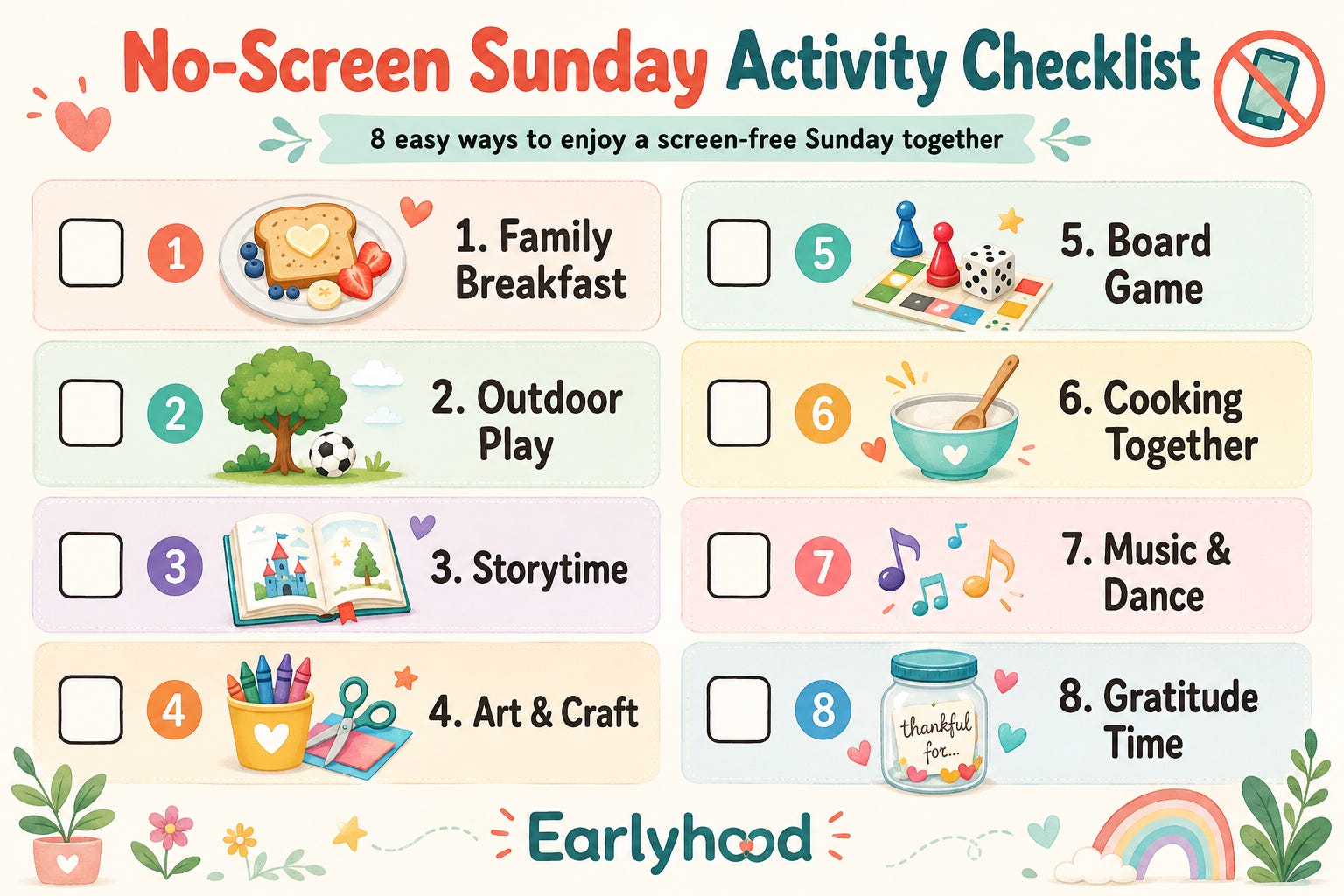
A better starting point is a simple family ritual: No-Screen Sunday.
No-Screen Sunday does not mean the whole day has to be perfect. It simply means choosing one day, or even a few hours, where the family replaces screens with real play, movement, stories, art, food, music, and conversation.
The goal is not punishment.
The goal is connection.
Why Try a No-Screen Sunday?
Children need screen-free time to use their body, imagination, language, creativity, and social skills.
When children are not watching screens, they slowly learn to:
Play independently
Create their own ideas
Talk more
Move more
Read more
Help at home
Spend time with family
Handle boredom
Explore real-world activities
At first, the child may resist. This is expected.
If screens are part of the daily routine, the child may not immediately know what else to do. Parents need to guide the transition gently.
Do not announce it like a strict rule.
Say:
“Today we are trying a fun family Sunday.”
“Screens will rest today, and we will play together.”
“Let’s make today a story, art, and outdoor day.”
The tone should feel positive.
Start With a Small Goal
Do not begin with a full-day screen-free challenge if your child is used to screens for many hours.
Start small.
Try:
One screen-free hour
Screen-free morning
Screen-free evening
Screen-free meal time
Screen-free family walk
Screen-free storytime before bed
Once the child adjusts, slowly increase.
The first goal is to help the child experience that life without screens can still be fun.
Prepare Activities Beforehand
A no-screen day works better when parents are prepared.
If screens are removed but nothing else is planned, children may feel bored and restless.
Keep a small Sunday activity basket ready.
Add:
Crayons
Paper
Storybooks
Blocks
Puzzles
Clay
Stickers
Board games
Toy animals
Flashcards
Music instruments
Ball
Bubbles
Old cardboard box
Colour paper
You do not need expensive toys. Simple things work well when parents join for a few minutes.
Create a Simple Sunday Plan
Children feel calmer when they know what comes next.
Make a simple plan:
Morning: Family breakfast and free play
Late morning: Outdoor walk or park time
Afternoon: Storytime and rest
Evening: Art, music, cooking, or board game
Night: Bedtime story
Keep the plan flexible.
Children do not need back-to-back activities. They also need time to play freely, sit quietly, and even feel a little bored.
Boredom is not always bad. It can become the beginning of imagination.
Use Outdoor Time
Outdoor play is one of the best screen replacements.
Take your child to a park, apartment play area, terrace, garden, or even for a short walk.
Try:
Running races
Cycling
Ball play
Nature walk
Leaf collecting
Bubble play
Hopscotch
Bird watching
Cloud watching
Treasure hunt
Watering plants
Outdoor play helps children use energy and return home calmer.
Even 20–30 minutes can make a difference.
Add Storytime
Books are a powerful no-screen activity.
Choose picture books, animal stories, short moral stories, folk tales, or bedtime books.
For younger children, do not worry about reading every word. Point to pictures, make sounds, ask questions, and let the child talk.
Ask:
“What do you see?”
“Where is the dog?”
“What will happen next?”
“Which character do you like?”
“Can we make a new ending?”
Storytime builds language, imagination, listening, and parent-child connection.
Try Art and Craft
Art keeps children engaged without screens.
Try simple activities:
Free drawing
Paper tearing and pasting
Finger painting
Sticker art
Clay play
Leaf printing
Paper crown
Handprint art
Greeting card
Cardboard box craft
Do not focus on perfection.
Avoid saying, “Colour properly” or “This does not look nice.”
Instead, say:
“Tell me about your picture.”
“I like how you used colours.”
“You made your own idea.”
“Let’s add something new.”
Art helps children express themselves and stay creatively busy.
Let Children Help at Home
Children enjoy feeling useful.
On No-Screen Sunday, include them in small household tasks.
They can:
Set plates
Wash fruits
Water plants
Fold small towels
Arrange books
Sort toys
Mix batter
Pack school bag
Keep clothes in basket
Help make a snack
Do not expect perfect work. The goal is participation.
Say:
“Thank you for helping.”
“You are part of our family team.”
“We did this together.”
This builds independence and bonding.
Make Food a Family Activity
Cooking is a wonderful screen-free activity.
Try simple child-friendly food activities:
Fruit bowl
Lemon water
Mini sandwich
Dosa topping
Curd rice mixing
Homemade bhel
Chapati rolling
Sprout chaat
Vegetable sorting
Simple ladoo shaping
Children learn food names, textures, colours, counting, patience, and responsibility.
They also feel proud when the family eats something they helped prepare.
Keep Screens Away During Meals
Meal time is a good place to start screen-free habits.
Instead of cartoons during food, try conversation.
Ask:
“What did you enjoy today?”
“What should we do next Sunday?”
“What made you laugh?”
“What was your favourite food?”
“What story should we read tonight?”
At first, the child may eat slower or ask for screens. Stay calm.
Use small conversation, songs, or family stories to make meals warm and connected.
Expect Resistance
Children may say:
“I am bored.”
“I want mobile.”
“Just one video.”
“This is not fun.”
“I don’t want to play.”
Do not panic.
This is part of the process.
Stay calm and offer two choices:
“Do you want blocks or drawing?”
“Storytime or puzzle?”
“Park walk or terrace play?”
“Clay or stickers?”
Choices help children feel some control.
Avoid long lectures about screen harm. Keep the mood light and steady.
Parents Must Join Too
No-Screen Sunday works best when parents also reduce phone use.
Children notice everything.
If parents are scrolling while asking children not to watch screens, the rule feels unfair.
Keep phones away during family activities as much as possible.
Even one hour of full parent attention can mean a lot to a child.
You can call it:
Family Hour
Sunday Play Hour
No-Phone Time
Together Time
Screen-Free Sunday
Make it a family ritual, not only a child rule.
Earlyhood Tip
Use this simple formula:
Replace, don’t just remove.
Do not only take screens away. Replace them with play, outdoor time, stories, art, music, helping, and family connection.
Children leave screens more easily when real life feels interesting.
Final Thought
No-Screen Sunday does not have to be perfect.
There may be boredom, resistance, mess, and negotiation. That is okay.
The purpose is not to prove that screens are bad. The purpose is to show children that joy can come from many other places too.
A storybook.
A family walk.
A paper crown.
A board game.
A homemade snack.
A silly dance.
A small conversation.
A parent sitting beside them.
These simple moments help children reconnect with play, imagination, movement, and family.
Start with one hour.
Repeat it every Sunday.
Slowly, it can become a beautiful family habit.
Because childhood needs screens less than it needs presence, play, and connection.
Join the Earlyhood Parent Community for trusted guidance on learning, parenting, health, preschool, activities, and storytime for children aged 0–8.