


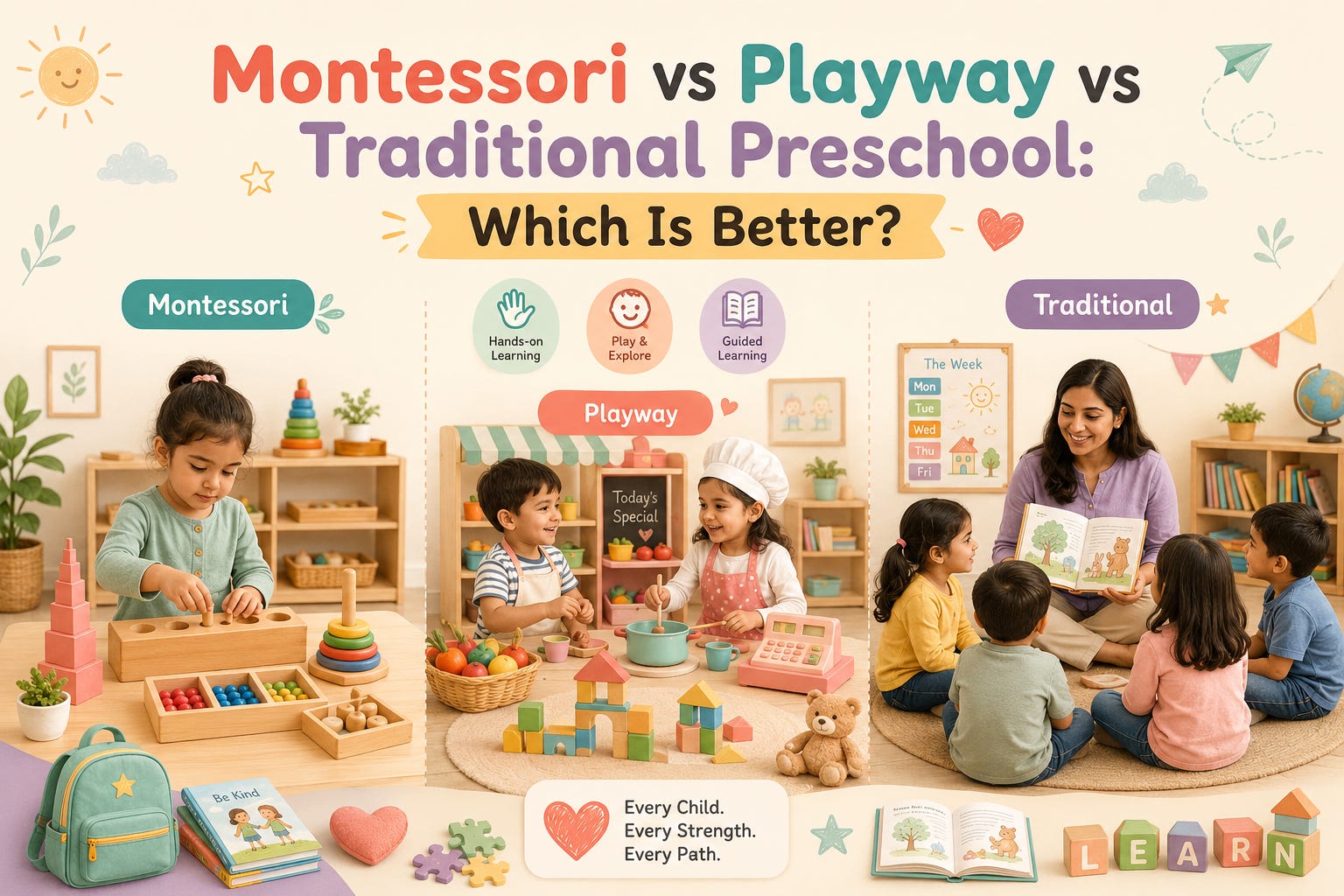
Choosing a preschool is already confusing for parents.
Then comes another confusing question:
Should we choose Montessori, Playway, or Traditional preschool?
Many schools use these words during admission counselling. Some say Montessori is best. Some say Playway is better for young children. Some say Traditional preschool prepares children better for formal school.
Parents naturally feel unsure.
The truth is simple: no single method is perfect for every child.
A preschool method matters, but what matters even more is how the school actually uses that method in daily life. A school may call itself Montessori but still push worksheets. Another may say Playway but lack structure. A Traditional preschool may be caring and balanced, or it may become too academic too early.
So parents should not choose only by label.
They should understand what each approach means, how it feels in the classroom, and whether it supports the child’s comfort, curiosity, independence, language, play, and emotional growth.
What Is a Montessori Preschool?
Montessori education focuses on independence, hands-on learning, order, concentration, and self-paced exploration.
In a Montessori classroom, children often work with specially designed learning materials. These materials help children explore practical life skills, sensorial learning, early math, language, coordination, and independence.
A Montessori environment usually gives children freedom within limits. Children may choose activities, work quietly, repeat tasks, and build concentration.
Common Montessori activities may include:
Pouring water
Buttoning frames
Sorting objects
Matching shapes
Sound and letter materials
Number rods
Pink tower
Practical life trays
Sensorial materials
Rolling mats
Independent work
Montessori can be helpful for children who enjoy hands-on work, order, repetition, independence, and calm classroom routines.
But the quality depends heavily on teacher training, classroom setup, and how faithfully the school follows the method.
What Is a Playway Preschool?
Playway focuses on learning through play.
This approach understands that young children learn best when they move, explore, pretend, sing, touch, build, talk, draw, and interact.
A Playway classroom may include stories, rhymes, art, blocks, pretend play, outdoor play, music, movement, puzzles, role play, sensory play, and group activities.
The goal is to make learning joyful and age-appropriate.
Common Playway activities may include:
Storytelling
Free play
Pretend kitchen
Blocks
Rhymes
Action songs
Art and craft
Clay play
Outdoor games
Circle time
Puppet play
Sand and water play
Simple group games
Playway can be very helpful for young children because it protects childhood from early academic pressure.
It works especially well when the school has thoughtful teachers who know how to connect play with language, social skills, motor development, and early concepts.
What Is a Traditional Preschool?
A Traditional preschool usually follows a more structured classroom routine.
It may include teacher-led lessons, group instruction, alphabet and number learning, rhymes, writing practice, worksheets, colouring, classroom discipline, and preparation for formal school.
Traditional preschools often focus on school readiness.
Common activities may include:
Alphabet learning
Number writing
Worksheet practice
Rhymes
Copy writing
Colouring
Simple reading readiness
Classroom instructions
Group learning
Book-based activities
Regular assessments
A Traditional approach can help some children become comfortable with classroom routines, sitting time, instructions, and formal school expectations.
But if it becomes too worksheet-heavy or pressure-based too early, it may reduce joy, creativity, and confidence.
Young children need more than sitting and writing. They need movement, play, stories, conversation, and exploration.
Montessori vs Playway vs Traditional: Simple Difference
Here is a simple way to understand the difference.
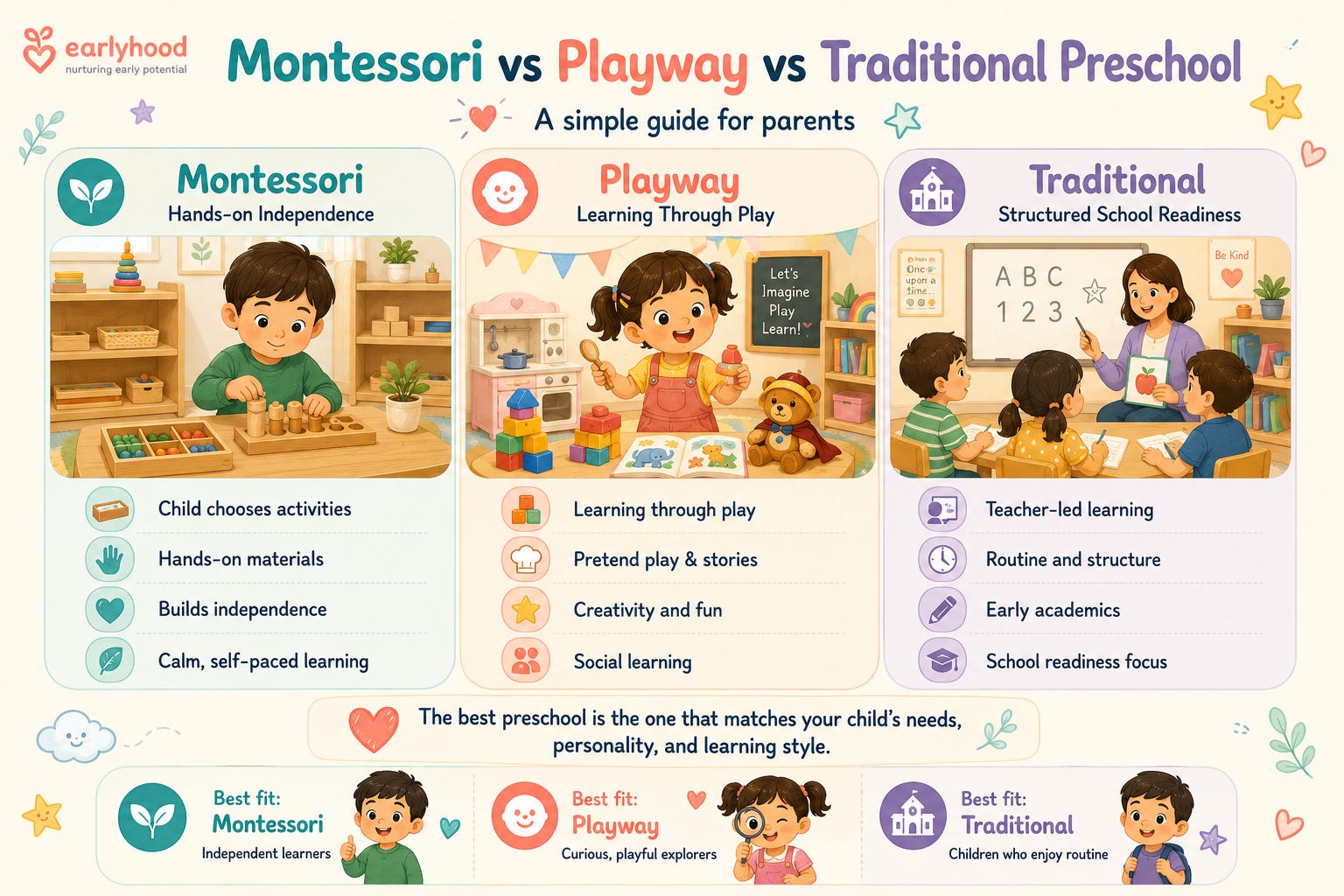
Montessori:
Learning through structured, hands-on materials and independence.
Playway:
Learning through free play, guided play, stories, movement, and imagination.
Traditional:
Learning through teacher-led lessons, routines, books, and structured academic preparation.
All three can work well when done thoughtfully.
All three can also fail when done poorly.
The label is less important than the child’s actual daily experience.
Which Approach Is Best for Age 2–3?
For children aged 2–3, the preschool should be gentle, warm, playful, and emotionally safe.
At this age, children are still learning separation, toilet routines, communication, sharing, and basic independence.
A strong Playway or gentle Montessori environment can work well.
The focus should be:
Settling
Free play
Music
Movement
Stories
Sensory play
Practical life skills
Teacher bonding
Simple routines
Language exposure
Heavy writing, homework, strict discipline, and long sitting time are not ideal for this age.
For 2–3 years, emotional comfort matters more than academic output.
Which Approach Is Best for Age 3–4?
At 3–4 years, children become more curious, social, and ready for simple routines.
Montessori can support independence and concentration. Playway can support imagination, language, movement, and social play. A balanced Traditional preschool can support routine and early concept exposure if it is not too academic.
For this age, the best preschool should include:
Play
Stories
Rhymes
Outdoor movement
Fine motor activities
Pretend play
Language building
Practical life skills
Early colours, shapes, numbers, and sounds
Social interaction
Parents should avoid schools that promise too much writing or reading too early.
Which Approach Is Best for Age 4–6?
At 4–6 years, children slowly become more ready for structured learning.
This does not mean play should disappear.
A good preschool at this age should balance school readiness with creativity, independence, physical movement, and emotional confidence.
Montessori can help with hands-on concepts and independent work. Playway can keep learning joyful and active. Traditional structure can help with formal school readiness when used gently.
The best approach for 4–6 years is often a balanced one.
Children need:
Phonics or sound awareness
Pre-writing skills
Early number concepts
Storytelling
Conversation
Drawing and craft
Outdoor play
Group activities
Independence
Social skills
Problem-solving
Short structured tasks
The goal is readiness, not pressure.
What Should Parents Look for Beyond the Method?
Before choosing, parents should observe the actual classroom.
Ask:
Are children happy and engaged?
Are teachers warm and patient?
Is there enough play?
Is there too much writing?
Are children allowed to ask questions?
Is the classroom safe?
Are activities age-appropriate?
Is there outdoor play?
How are children comforted when they cry?
How are mistakes handled?
How does the school update parents?
A preschool method is only as good as the people implementing it.
A caring teacher matters more than a fancy label.
Questions to Ask During Admission
Parents can ask these simple questions:
What does a typical day look like?
How much free play is included?
How much outdoor play is included?
How much writing is expected?
How do you introduce letters and numbers?
How do you handle children who take time to adjust?
How do you support shy children?
How do teachers guide behaviour?
How do you balance play and academics?
What makes your approach suitable for my child’s age?
The answers should feel clear and child-focused.
Avoid schools that only talk about early academic performance, competition, or how quickly children will write and read.
Signs of a Good Preschool Approach
A good preschool approach should show these qualities:
Children feel safe
Teachers speak kindly
Learning is age-appropriate
Play is respected
Children get movement time
Activities are meaningful
There is emotional warmth
The classroom is clean and safe
Parents get clear communication
Children are not shamed for mistakes
Curiosity is encouraged
Independence is supported
Whether the school calls itself Montessori, Playway, Traditional, or blended, these signs matter most.
When a Blended Approach Can Work Well
Many modern preschools use a blended approach.
They may take Montessori-style practical life activities, Playway-style storytelling and pretend play, and Traditional-style school readiness activities.
This can work well if the balance is right.
A blended preschool may give children the best of all worlds:
Independence from Montessori
Joy from Playway
Routine from Traditional learning
Confidence from social activities
Readiness from structured tasks
But the blend should not become confusion.
Parents should ask how the school plans the day and what children actually do.
Earlyhood Tip
Do not choose a preschool only by the name of the method.
Choose by the child’s daily experience.
Use this simple rule:
Warm teachers. Safe space. Enough play. Gentle structure. Age-appropriate learning.
That matters more than any label.
Final Thought
Montessori, Playway, and Traditional preschool methods all have value.
Montessori supports independence and hands-on learning.
Playway protects joy, movement, imagination, and exploration.
Traditional structure can support school readiness when used gently.
But no method works well without caring teachers, emotional safety, age-appropriate activities, and parent communication.
So instead of asking, “Which method is best?”
Ask:
“Which preschool will help my child feel safe, curious, confident, and happy to learn?”
That is the better question.
Because the best preschool method is not the one that sounds most impressive.
It is the one that respects childhood.
Join the Earlyhood Parent Community for trusted guidance on learning, parenting, health, preschool, activities, and storytime for children aged 0–8.