


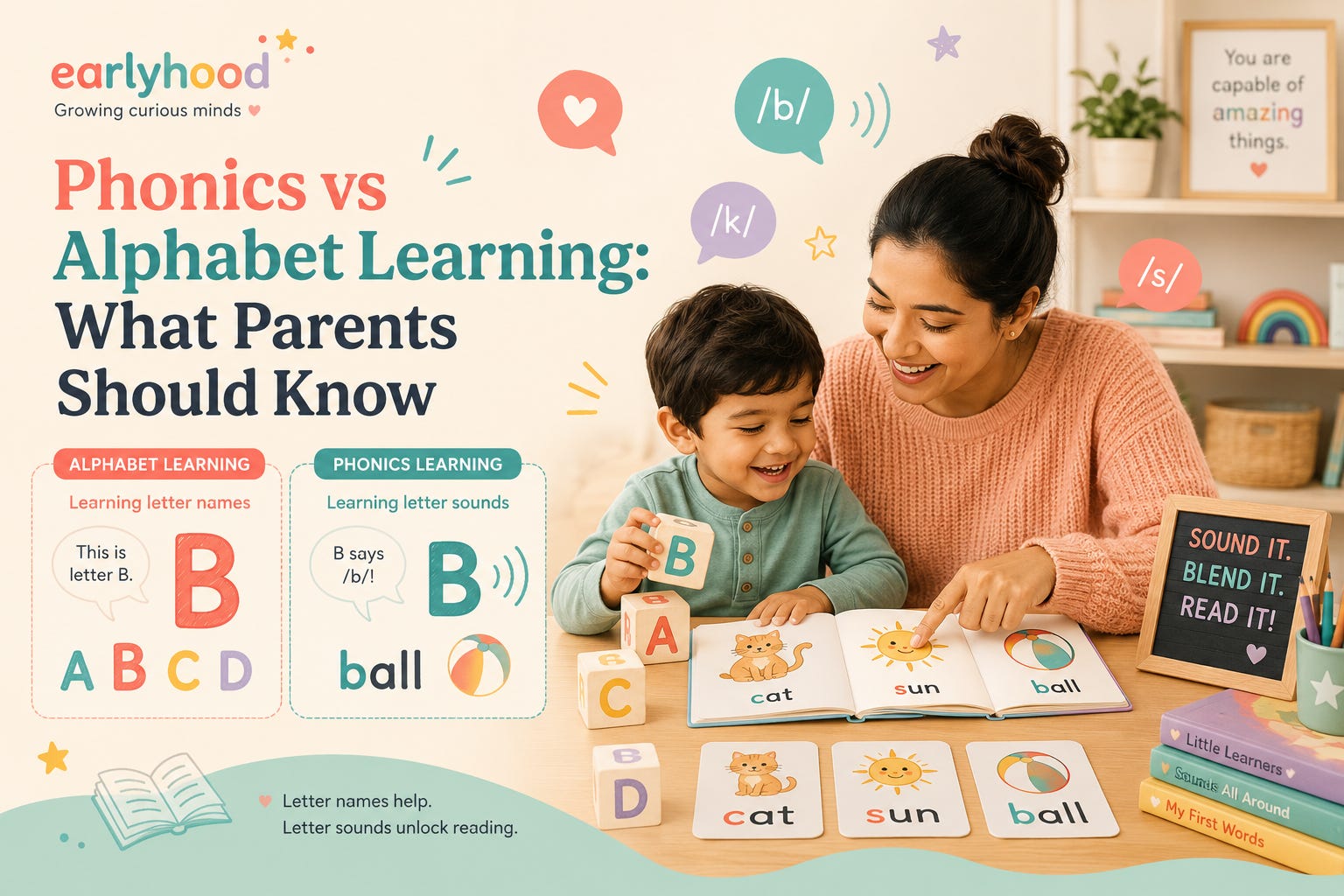
Many parents begin early learning with alphabets.
They teach children A, B, C, ask them to identify letters, buy alphabet charts, play alphabet songs, and celebrate when the child can say all 26 letters.
This is a good start.
But many parents later notice one problem: their child can say A to Z, but still cannot read simple words.
That is because knowing letter names is not the same as understanding how reading works.
Reading needs more than alphabet memorisation. Children also need to understand sounds. This is where phonics comes in.
So parents often ask:
“What is better — phonics or alphabet learning?”
“Should my child learn ABC first?”
“When should phonics start?”
“Is phonics necessary for reading?”
The answer is simple: children need both, but in the right way and at the right pace.
What Is Alphabet Learning?
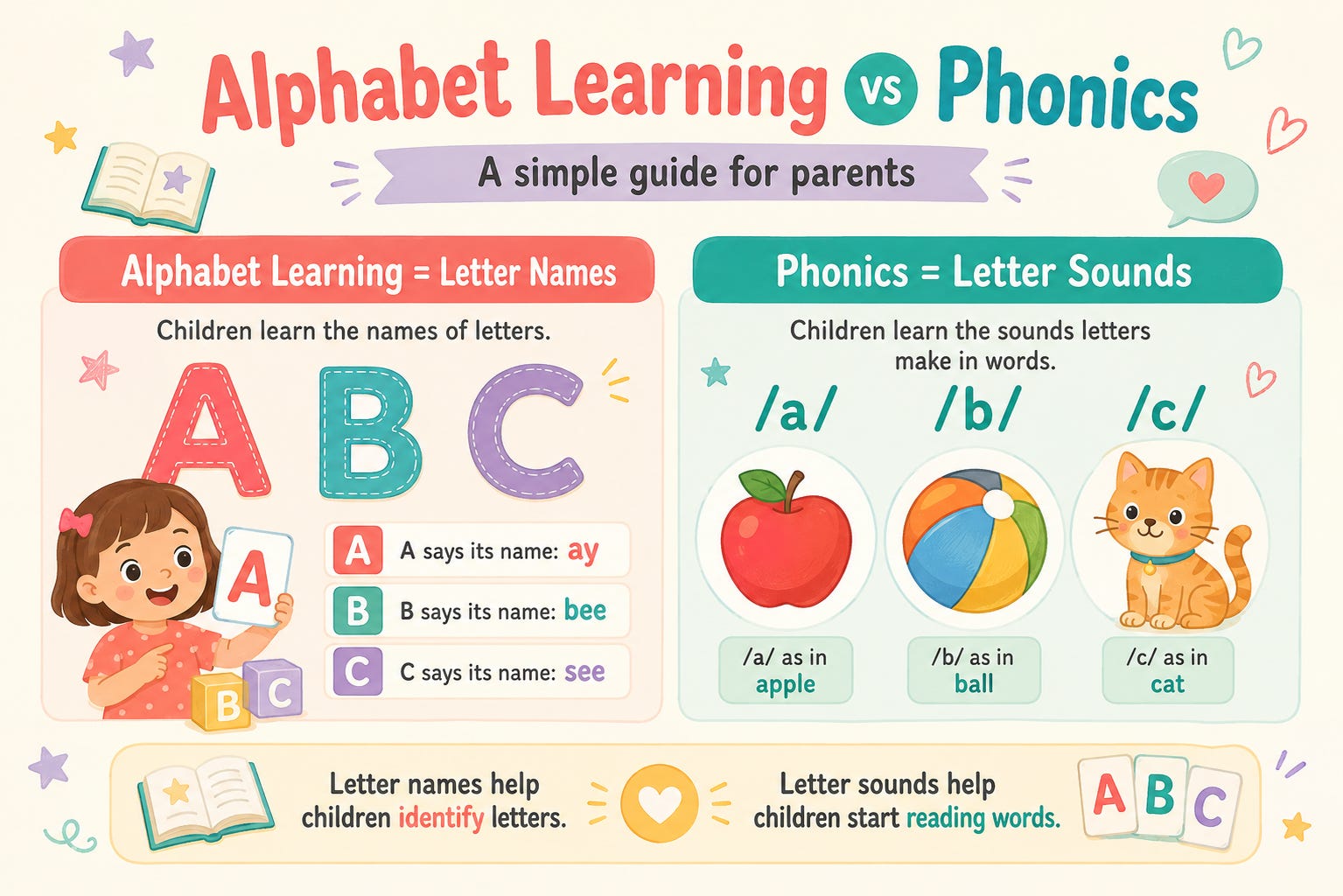
Alphabet learning means helping children recognise letters and their names.
For example:
A is called “ay”
B is called “bee”
C is called “see”
Alphabet learning helps children identify written letters, understand that letters have names, and become familiar with printed language.
Children may learn alphabets through:
Alphabet songs
Letter charts
Picture books
Flashcards
Magnetic letters
Alphabet blocks
Tracing letters
Letter puzzles
Everyday labels
Alphabet learning is useful because children need to recognise letters before they can read and write confidently.
But alphabet learning alone is not enough.
A child may know that the letter is called “B,” but to read the word “bat,” the child needs to understand that B makes the /b/ sound.
That sound connection is phonics.
What Is Phonics?
Phonics teaches children the relationship between letters and sounds.
For example:
B makes /b/ sound
M makes /m/ sound
S makes /s/ sound
C can make /k/ sound in cat
A can make /a/ sound in apple
Phonics helps children understand how words are built.
When a child learns that c-a-t makes “cat,” they are using phonics.
Phonics supports reading because it helps children decode new words instead of only memorising them.
For example, if a child knows the sounds /m/, /a/, and /t/, they can blend them to read “mat.” Later, they can also try “sat,” “bat,” “cat,” and “rat.”
This gives children confidence because they begin to see patterns in words.
Which Should Come First?
Alphabet exposure can start early through songs, books, and playful activities.
But parents do not need to force children to memorise all letters before introducing sounds.
Both can grow together.
For example, when showing the letter M, you can say:
“This is M. M says /m/. Mmm… mango.”
When showing the letter B, say:
“This is B. B says /b/. Ball begins with /b/.”
This way, the child learns the letter name, the letter shape, and the sound together.
For children aged 2–4, keep it playful and simple.
For children aged 4–6, phonics can become more structured through sound games, rhyming, blending, and early reading practice.
Why Alphabet Memorisation Is Not Enough
Many children can recite A to Z beautifully because they remember the song.
But reading is not singing the alphabet.
Reading means connecting print with sounds and meaning.
A child may say A to Z, but still struggle to read “sun” because they do not know that:
S says /s/
U says /u/
N says /n/
/s/ + /u/ + /n/ becomes sun
This is why parents should not worry only about whether the child can say alphabets in order.
Instead, observe whether the child can:
Recognise letters
Hear sounds in words
Match letters with sounds
Notice rhyming words
Blend simple sounds
Enjoy books
Understand stories
Show interest in print
These skills together support reading readiness.
Start With Sounds in Daily Life
Before formal phonics, children should first enjoy sounds.
You can play simple sound games at home:
“What starts with /b/? Ball, banana, bag.”
“Can you hear /m/ in mango?”
“Sun and fun sound the same at the end.”
“Cat, mat, bat — these words rhyme.”
Use playful listening activities:
Clap syllables in names
Find words that begin with the same sound
Sing rhyming songs
Read books with repeated sounds
Play “I spy something starting with /t/”
Sound awareness helps children notice that spoken words are made of smaller sounds.
This makes phonics easier later.
Use Books Before Worksheets
Phonics should not become only worksheet practice.
Children learn better when sounds are connected to stories, pictures, objects, and real words.
Instead of only writing “A” ten times, show the child a picture book and say:
“Apple starts with /a/.”
“Ant also starts with /a/.”
“Can you find another /a/ word?”
Instead of only tracing B, use blocks, books, and objects:
“Ball starts with /b/.”
“Baby starts with /b/.”
“Bag starts with /b/.”
Reading should feel meaningful, not mechanical.
Avoid Rushing Into Writing
Some parents feel that once a child knows letters, they should immediately start writing.
But writing needs hand strength, finger control, pencil grip, sitting tolerance, and visual coordination.
Before writing letters, children need many pre-writing activities:
Clay play
Scribbling
Colouring
Tracing lines
Threading beads
Building blocks
Tearing paper
Sticking stickers
Drawing shapes
Using tongs or spoons
These activities prepare the hand for writing.
A child can learn letter sounds and enjoy books even before perfect writing begins.
Common Mistakes Parents Make
Parents often make these mistakes:
Only teaching A to Z memorisation
Forcing writing too early
Using too many worksheets
Correcting every small mistake
Teaching capital letters only
Making reading feel like a test
Comparing with other children
Ignoring story reading
Expecting instant blending
Not repeating enough through play
Early reading grows slowly. Children need repeated exposure, not pressure.
Simple Home Plan for Ages 3–6
For young children, keep the plan light and joyful.
Ages 3–4:
Alphabet songs, picture books, rhymes, sound games, matching objects, storytelling, scribbling, and playful letter exposure.
Ages 4–5:
Letter-sound matching, beginning sound games, rhyming, simple blending, name letters, alphabet puzzles, and daily story reading.
Ages 5–6:
Simple phonics practice, blending CVC words like cat, mat, sun, pen, reading short words, word families, and beginner books.
Do not rush the child through all stages.
Reading confidence grows with time, repetition, and encouragement.
Earlyhood Tip
Use this simple approach:
Letter name + letter sound + real object + story connection.
For example:
“This is S. S says /s/. Sun starts with /s/. Let’s find the sun in this book.”
This makes learning natural and meaningful.
Final Thought
Alphabet learning and phonics are not enemies.
Alphabet learning helps children recognise letters.
Phonics helps children understand how letters make sounds and form words.
Stories help children understand meaning.
Play helps children enjoy the process.
A child who only memorises A to Z may not automatically become a reader.
But a child who hears sounds, enjoys books, recognises letters, plays with words, and slowly learns phonics builds a stronger reading foundation.
So do not rush.
Sing the alphabet song. Read picture books. Play sound games. Use real objects. Talk often. Let your child enjoy language.
Because reading begins not with pressure, but with curiosity, sound, stories, and joy.
Join the Earlyhood Parent Community for trusted guidance on learning, parenting, health, preschool, activities, and storytime for children aged 0–8.