


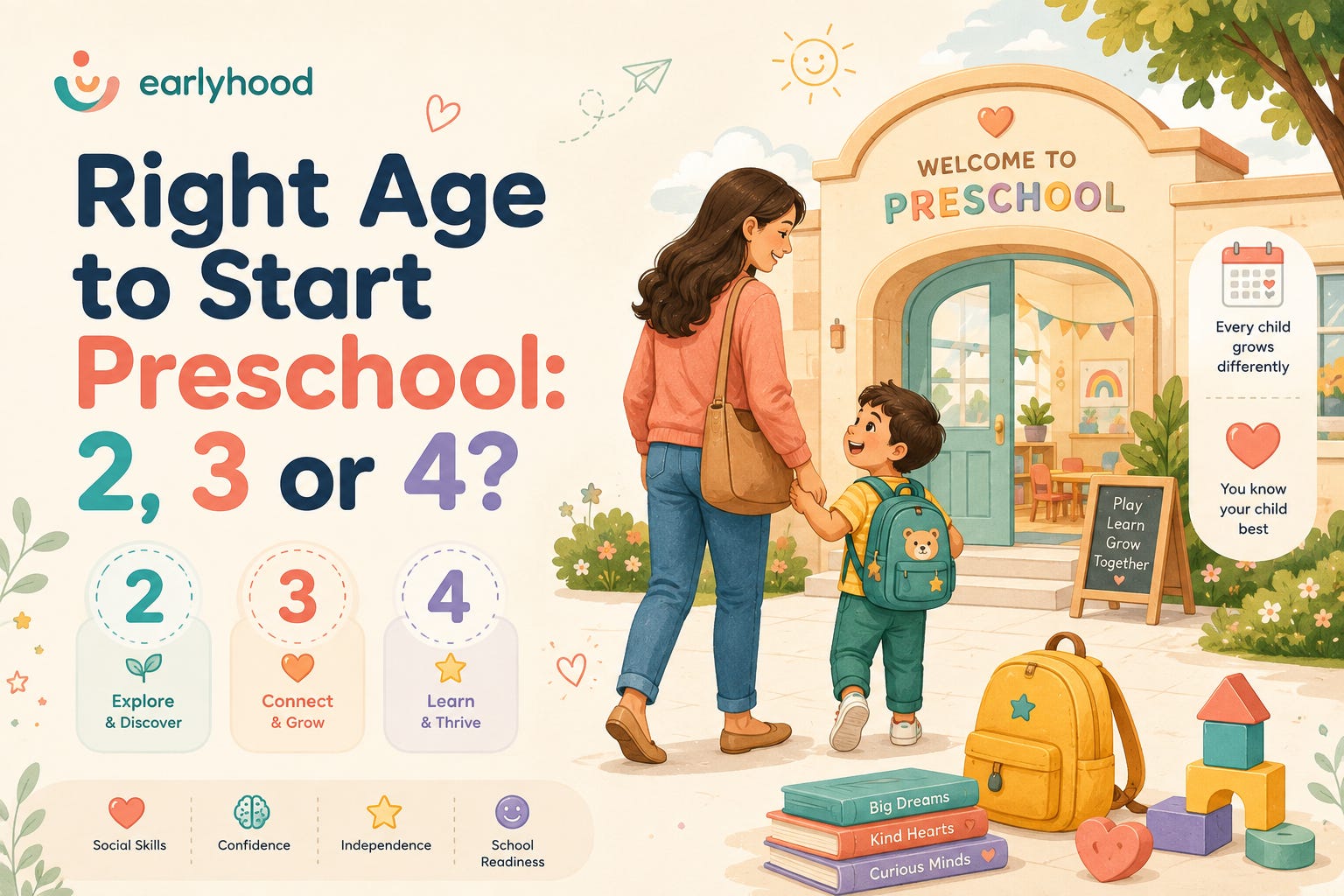
One of the most common questions parents ask is:
“When should my child start preschool?”
Some parents start at 2 years. Some wait until 3. Some prefer 4. Some feel pressure because other children in the neighborhood have already started. Some worry their child may fall behind if they delay preschool.
The truth is simple: there is no one perfect age for every child.
Preschool readiness is not only about age. It is about how ready the child is emotionally, socially, physically, and practically.
A child may be 2.5 years old and happily ready for a short playgroup. Another child may be 3.5 years old and still need a slower transition. Both can be normal.
Instead of asking only, “Is my child old enough?” parents should ask, “Is my child ready for this environment?”
Starting Preschool at Age 2
At around 2 years, some children may begin with a playgroup or short-duration preschool programme.
This can work well when the preschool is gentle, play-based, and not academically heavy.
At this age, children are still very young. They may be attached to parents, may not speak clearly yet, may need help with toilet routines, and may cry during separation.
So the focus should not be writing, reading, or formal learning.
For a 2-year-old, preschool should mainly offer:
Short separation practice
Free play
Rhymes and music
Sensory play
Simple stories
Movement
Social exposure
Routine building
Gentle teacher bonding
A 2-year-old should not be forced into long hours if they are not comfortable.
Short sessions work better. A calm settling period is very important.
Starting Preschool at Age 3
For many children, age 3 can be a comfortable time to begin preschool.
By this age, many children can communicate basic needs, understand simple instructions, play near other children, enjoy stories, and participate in routines.
They may still cry in the beginning, but many adjust gradually with teacher support.
At age 3, preschool can support:
Language development
Social skills
Play-based learning
Fine motor skills
Movement
Independence
Sharing and turn-taking
Storytelling
Early numbers and colours
Emotional confidence
This is also the age when children often enjoy group songs, pretend play, art, puzzles, outdoor play, and simple classroom routines.
But even at 3, preschool should remain playful. It should not become a pressure-filled academic space.
Starting Preschool at Age 4
Starting preschool at 4 can also be completely okay.
Some children benefit from more time at home, especially if they are shy, sensitive, frequently unwell, or not yet ready for separation. By age 4, many children have better language, stronger motor skills, more independence, and better ability to follow routines.
A 4-year-old may adjust faster because they can understand what school is, talk about feelings, follow classroom instructions, and interact with other children more easily.
Preschool at age 4 can help with:
School readiness
Social confidence
Longer attention span
Early literacy exposure
Pre-writing skills
Group participation
Problem-solving
Independence
Emotional expression
Parents should not feel guilty if they wait until 4.
A child does not fall behind simply because preschool starts a little later. What matters is that the child has enough opportunities for play, conversation, stories, movement, and social interaction at home or outside.
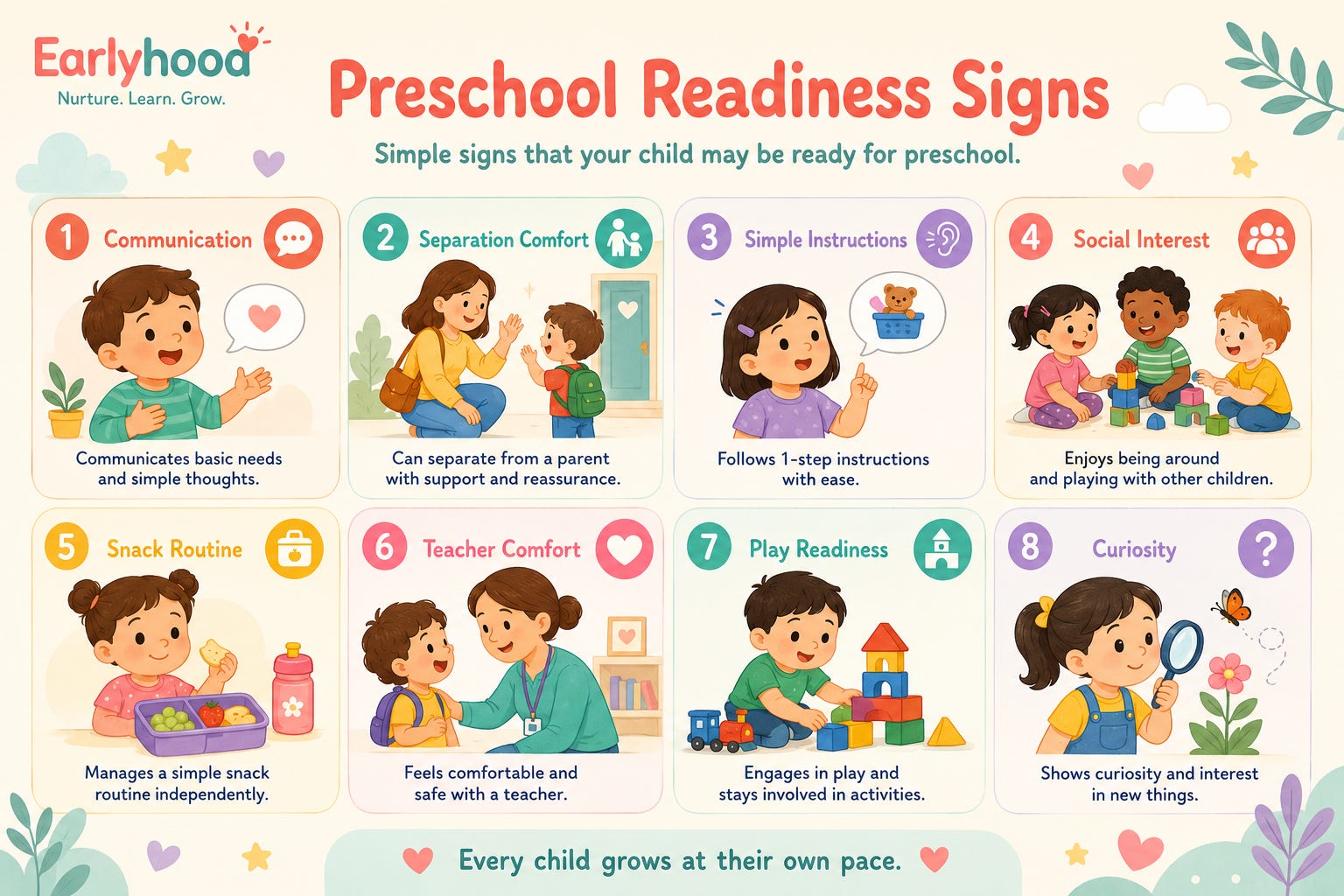
Signs Your Child May Be Ready for Preschool
Age is only one part of the decision.
Look for readiness signs such as:
Your child can stay away from you for short periods
Your child can communicate basic needs
Your child can follow simple instructions
Your child shows interest in other children
Your child enjoys stories, songs, or group play
Your child can sit for short activities
Your child is curious about new places
Your child can eat snacks with some help
Your child is beginning to manage small routines
Your child can be comforted by another trusted adult
Your child does not need to be perfect in all areas. Preschool is also a place where these skills grow.
But if your child is extremely distressed, unable to separate at all, or not ready for group settings, a slower approach may help.
Signs Your Child May Need More Time
Some children need more time before starting preschool.
Signs may include:
Very strong separation anxiety
Frequent illness or low stamina
Difficulty communicating basic needs
Extreme fear of new people
Overwhelm in noisy places
Not ready for even short group settings
Major sleep or routine struggles
Recent big life change at home
Strong resistance that continues for many weeks
This does not mean something is wrong.
It only means the child may need a gentler transition, shorter hours, more parent preparation, or a different preschool environment.
What Matters More Than Age?
The preschool environment matters more than the exact age.
A child may start at 2.5 years and enjoy preschool if the place is warm, safe, playful, and gentle. Another child may start at 3.5 years and struggle if the school is strict, crowded, or too academic.
Before deciding, parents should check:
Teacher warmth
Safety and hygiene
Class size
Settling process
Daily routine
Playtime
Communication with parents
Toilet support
Nap or rest policy
Distance from home
Child comfort during visit
The right preschool should support the child, not push the child too hard.
How to Prepare Your Child for Preschool
Preparation can make the transition smoother.
A few weeks before starting, begin simple routines at home.
Talk about school positively.
Read preschool-themed stories.
Visit the school with your child.
Practice short separation with trusted family.
Create a morning routine.
Let the child carry a familiar water bottle or bag.
Practice snack time.
Teach simple phrases like “I need water” or “I want toilet.”
Keep goodbye short and calm.
Do not say scary things like:
“Teacher will scold you.”
“You have to go to school or else…”
“Don’t cry like a baby.”
Instead, say:
“You may miss me. I will come back.”
“Your teacher will help you.”
“You can play, sing, and listen to stories.”
“I will pick you up after school.”
Earlyhood Tip
Think of preschool as a transition, not a race.
Some children are ready at 2. Some at 3. Some at 4.
A calm start is better than an early start filled with stress.
Choose the age and preschool environment that protects your child’s emotional comfort, curiosity, and confidence.
Final Thought
The right age to start preschool is not decided only by the calendar.
It is decided by your child’s readiness, your family routine, the preschool’s quality, and how gently the transition is handled.
Age 2 can work for short, playful exposure.
Age 3 is comfortable for many children.
Age 4 is also perfectly fine when a child needs more time.
Do not compare your child with others.
Your child’s early learning journey should begin with safety, warmth, play, trust, and joy.
Because preschool is not about rushing childhood.
It is about helping childhood open gently into learning.
Join the Earlyhood Parent Community for trusted guidance on learning, parenting, health, preschool, activities, and storytime for children aged 0–8.