


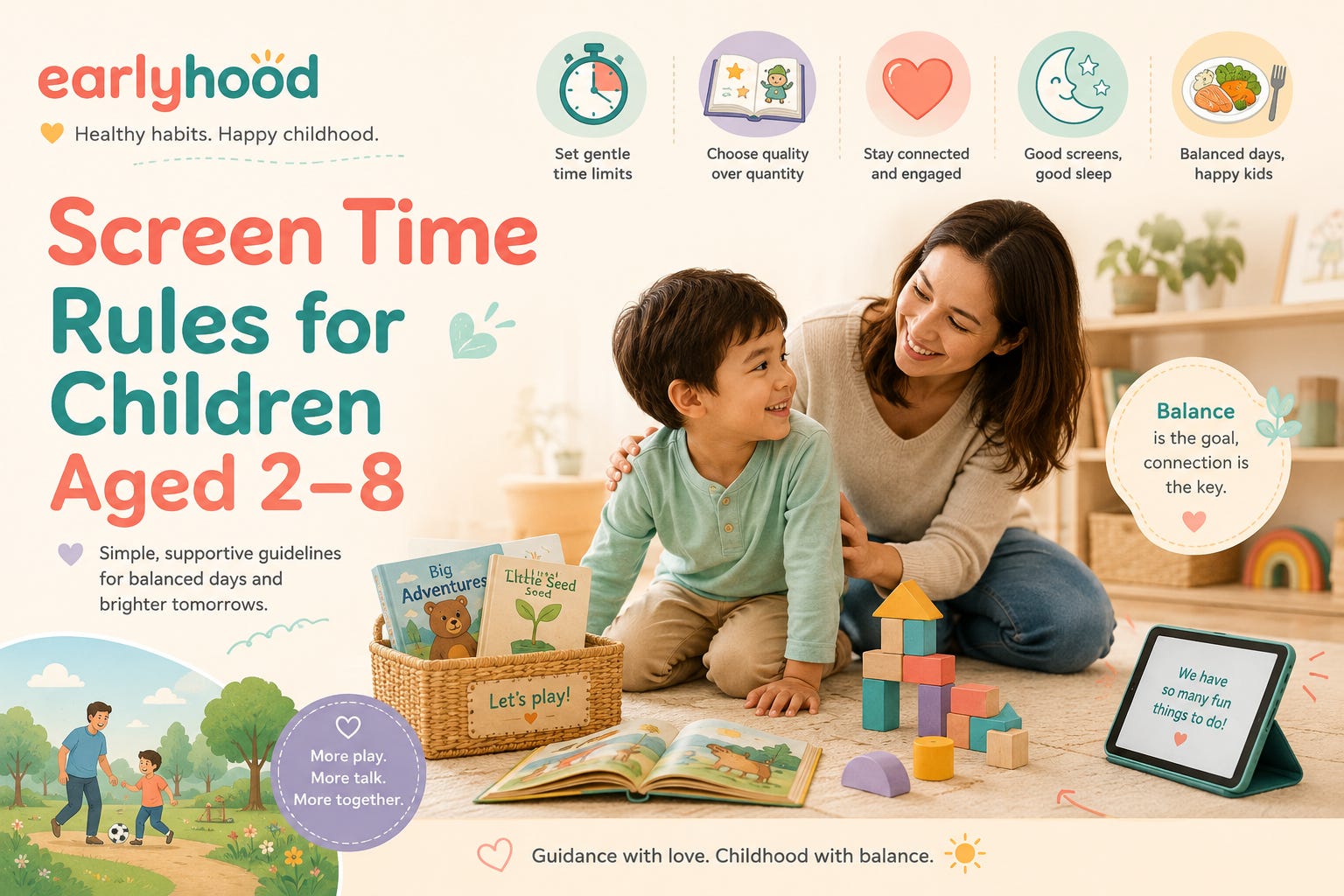
Screens are now part of family life.
Children watch rhymes, cartoons, learning videos, games, video calls, and stories. Sometimes screens help parents finish work, manage travel, or keep a child busy for a short time. But when screens become the easiest answer for boredom, tantrums, meals, or bedtime, they can slowly affect daily routines.
The goal is not to make parents feel guilty.
The goal is to build healthier screen habits that support a child’s learning, sleep, behaviour, emotions, and family connection.
For children aged 2–8, screen time should not only be about “how many minutes.” It should also be about what they watch, when they watch, how they watch, and what screen time is replacing. The American Academy of Pediatrics now encourages families to look beyond only a fixed time rule and think about the child, content, calming, crowding out, and communication — known as the “5 C’s” approach.
Why Screen Time Needs Rules
Children do not naturally know when to stop watching.
Many apps and videos are designed to keep attention for longer. Autoplay, fast colours, short clips, and endless recommendations can make it hard for young children to stop by themselves.
That is why children need adults to create boundaries.
Without rules, screen time can crowd out other important things like sleep, outdoor play, reading, drawing, talking, pretend play, family meals, and independent play. The AAP’s toddler and preschool guidance specifically asks parents to think about what media is getting in the way of, such as playing, moving, exploring nature, looking at books, and chatting with family.
Rule 1: Decide Screen Time Before the Child Asks
Do not decide screen time during a tantrum.
Make a simple family rule in advance.
For example:
Weekdays: 30–45 minutes after homework or play
Weekends: One planned movie or limited cartoon time
No screens: During meals, before school, and before bedtime
When the rule is already clear, parents do not have to negotiate every day.
Children may still protest, but consistency helps them understand the routine.
Rule 2: Choose Better Content
Not all screen time is equal.
A slow, age-appropriate, educational video watched with a parent is different from endless random videos. For toddlers and preschoolers, AAP guidance recommends choosing high-quality content and watching together so children can understand what they are seeing and connect it with real life.
Choose content that is:
Slow-paced
Age-appropriate
Positive
Language-rich
Non-violent
Not overloaded with ads
Easy to understand
Connected to real learning or stories
Avoid fast, noisy, random videos that quickly move from one clip to another. These can make stopping harder and may overstimulate children.
Rule 3: Watch Together When Possible
Co-viewing means watching with your child and talking about what they see.
You can ask:
“What happened in the story?”
“Was that kind or unkind?”
“What colour was the car?”
“What would you do?”
“Can we try this activity after the video?”
This turns screen time into a conversation instead of passive watching.
AAP guidance highlights that co-viewing can help parents guide children, build connection, and understand the child’s digital experience better.
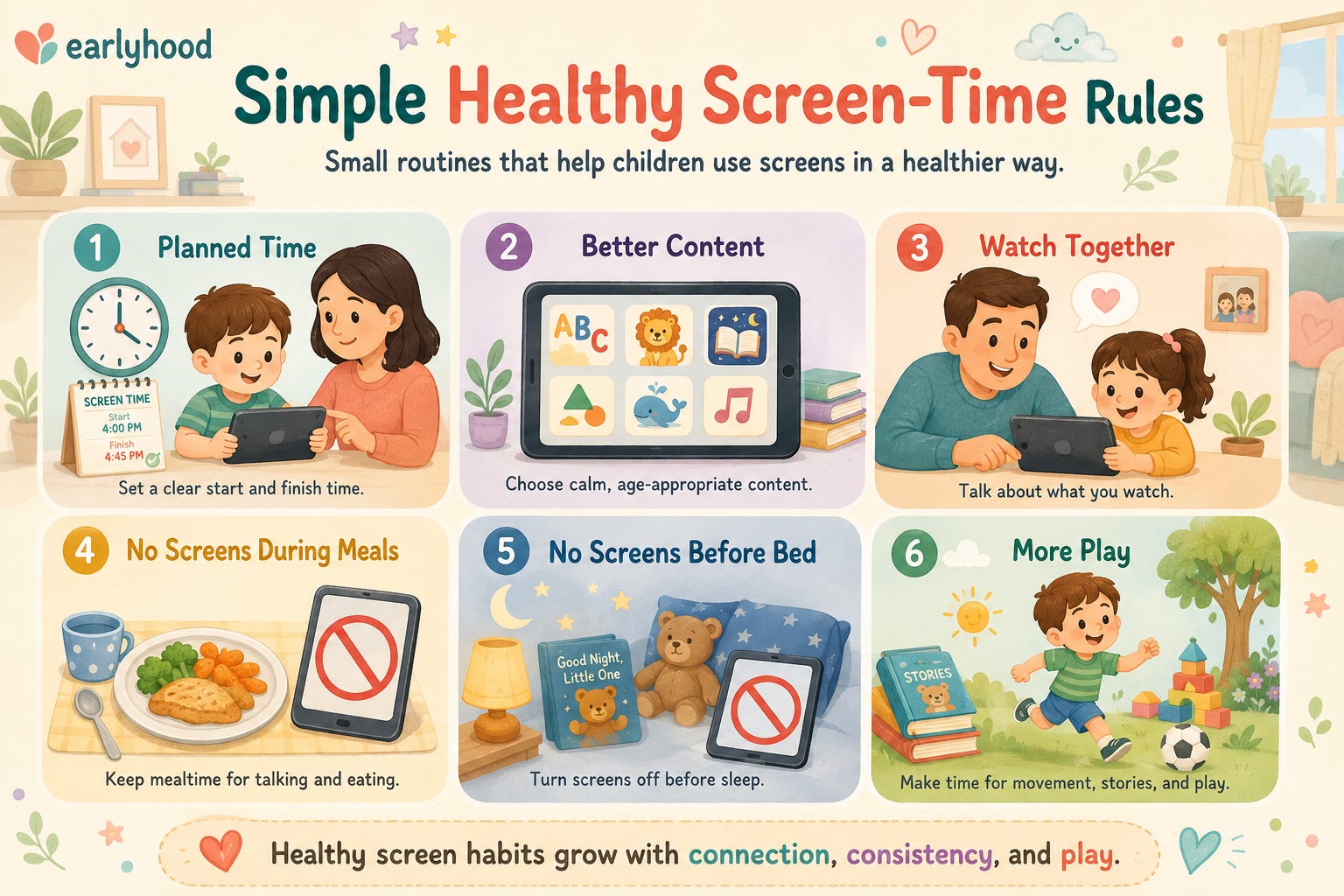
Rule 4: Avoid Screens During Meals
Mealtime is not only for eating. It is also for conversation, food habits, family bonding, and learning self-control.
When children eat with screens, they may not notice hunger, fullness, taste, or family interaction. Over time, they may start refusing food without a phone or TV.
Start small.
Try one screen-free meal daily.
Say:
“During food time, the phone rests.”
“We will watch later. Now we eat together.”
“Let’s talk about your day.”
This may be difficult at first, but children slowly adjust when the rule is consistent.
Rule 5: Keep Screens Away Before Bedtime
Evening screen time can make bedtime harder for many children.
Exciting videos, games, and bright screens can keep the mind active when the body should be slowing down. AAP’s earlier guidance recommends no screens during meals and for one hour before bedtime.
Replace bedtime screens with:
Storytime
Soft music
Quiet drawing
Cuddles
Bedtime routine chart
Picture books
Deep breathing
A soft toy ritual
A calmer evening usually leads to better sleep.
Rule 6: Do Not Use Screens as the Main Calming Tool
It is tempting to give a phone when a child cries, gets bored, or throws a tantrum.
Sometimes, during travel or emergencies, screens may help. But if screens become the main way to calm emotions, children may not learn other calming skills.
AAP’s 5 C’s guidance encourages parents to avoid using devices every time toddlers or preschoolers are upset or bored, and instead help them name feelings and calm down in other ways.
Try alternatives:
Hug
Water
Breathing
Soft toy
Quiet corner
Story
Walk
Simple choice
Naming the feeling
Say:
“You are upset. I am here.”
“Let’s breathe together.”
“You wanted more time. It is hard to stop.”
Rule 7: Replace, Don’t Only Remove
If you reduce screens without offering alternatives, children may struggle more.
Keep simple activities ready:
Blocks
Crayons
Books
Clay
Puzzles
Toy animals
Pretend kitchen
Music and movement
Indoor treasure hunt
Outdoor play
The World Health Organization’s guidance for young children also focuses on the overall daily pattern: less sedentary screen time, more active play, and good-quality sleep.
Simple Screen Time Guide for Ages 2–8
Ages 2–5:
Keep screen time limited, choose high-quality content, and watch together when possible. AAP guidance has commonly recommended limiting screen use for this age group to about one hour per day of high-quality programming, with parents helping children understand and apply what they see.
Ages 6–8:
Create clear family rules. Focus on balance: sleep, school, outdoor play, reading, hobbies, family time, and screen-free zones. AAP’s family media plan recommends screen-free zones such as the dinner table and before bed.
Earlyhood Tip
Use this simple rule:
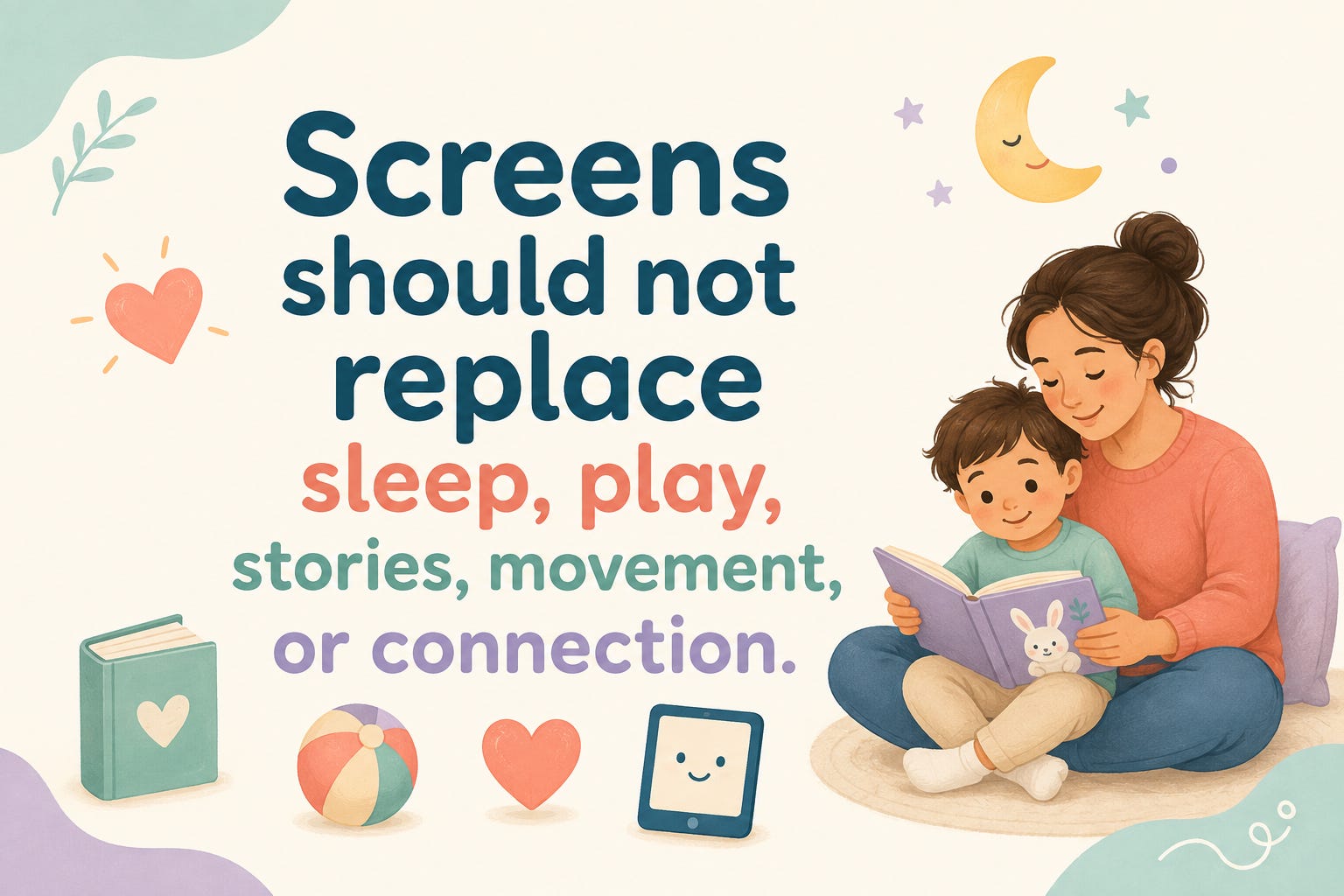
Screens should not replace sleep, play, food, stories, movement, or connection.
When these basics are protected, screen time becomes easier to manage.
Final Thought
Screens are not the enemy.
But children need parents to guide how screens fit into daily life.
Healthy screen habits are built through simple rules, better content, co-viewing, screen-free meals, calm bedtime routines, and plenty of real-world play.
Start with one rule this week.
Maybe no screens during meals.
Maybe no screens one hour before bed.
Maybe only one planned screen time daily.
Maybe watching together instead of leaving the child alone with random videos.
Small changes can create healthier habits.
Because childhood needs more than screens.
It needs stories, movement, imagination, conversations, play, and connection.
Join the Earlyhood Parent Community for trusted guidance on learning, parenting, health, preschool, activities, and storytime for children aged 0–8.