


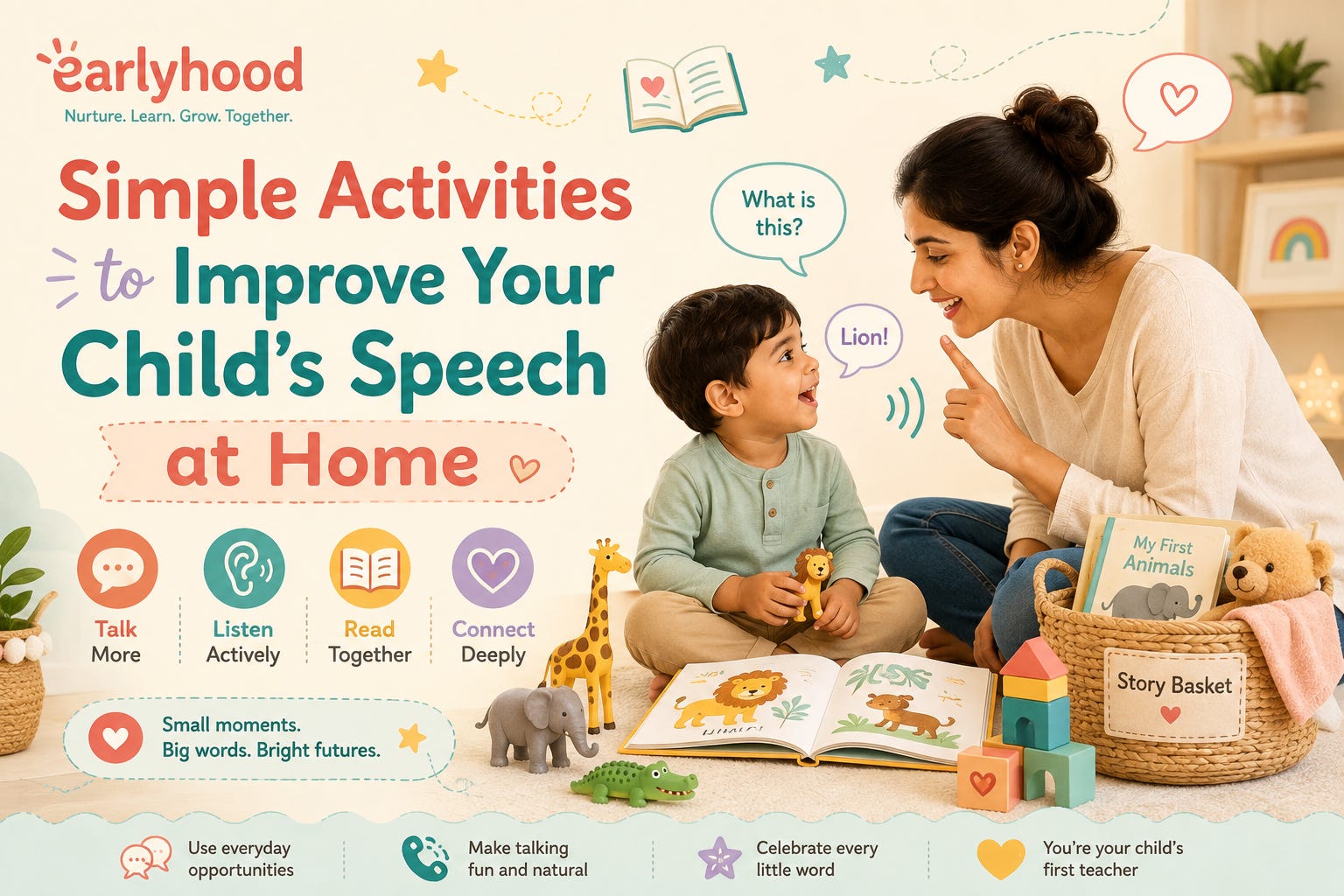
Many parents worry about their child’s speech.
Some children start talking early. Some take more time. Some use many words at home but become quiet outside. Some understand everything but speak very little. Some speak in single words when parents expect sentences.
This can make parents anxious.
But speech and language do not grow only through flashcards, classes, or repeating words on command. Children learn to communicate through daily interaction: hearing parents talk, watching expressions, copying sounds, naming objects, asking for help, listening to stories, singing songs, and playing with people.
The most powerful speech activities are often already inside your home.
The key is to use everyday moments more intentionally.
Speech Is More Than Saying Words
Speech means the sounds and words a child says.
Language means understanding and using words to express thoughts, needs, feelings, and ideas.
Communication also includes gestures, eye contact, pointing, expressions, body language, listening, and turn-taking.
So when parents support speech at home, they should not only ask the child to “say this” or “repeat that.”
They should create many chances for real communication.
The American Speech-Language-Hearing Association shares that parents can support preschool communication through simple home activities like talking, reading, singing, playing, describing, and encouraging back-and-forth interaction.
1. Talk During Daily Routines
Children learn words from repeated daily experiences.
You can talk while bathing, eating, dressing, walking, cooking, cleaning, or packing a bag.
Say simple lines:
“We are washing hands.”
“This is your blue towel.”
“The dosa is hot.”
“Open the box.”
“Your shoes are near the door.”
“Let’s put toys in the basket.”
Daily routine words are powerful because children hear them again and again.
Do not make it a lecture. Speak naturally and slowly.
2. Name What Your Child Sees
Children learn faster when words are connected to real things.
If your child is playing with a ball, say:
“Ball.”
“Big ball.”
“Red ball.”
“Throw the ball.”
“The ball is rolling.”
This helps the child hear the same word in different ways.
Use your child’s interest. If the child is looking at a dog, talk about the dog. If the child is holding a spoon, talk about the spoon.
Following the child’s interest makes language more meaningful.
3. Expand Your Child’s Words
When your child says one word, add one or two more words.
If the child says:
“Car.”
You can say:
“Yes, red car.”
“Car is moving.”
“Big car.”
“Car goes fast.”
If the child says:
“Water.”
You can say:
“You want water.”
“Cold water.”
“Drink water.”
This technique helps children slowly move from single words to short phrases without pressure.
The child does not have to repeat immediately. Hearing the expanded sentence again and again supports language growth.
4. Read Picture Books Every Day
Books are one of the best tools for speech and language.
You do not need to read perfectly. You can point, name, describe, ask, and pause.
Choose picture books with animals, family, food, vehicles, daily routines, emotions, colours, and simple stories.
While reading, say:
“Where is the cat?”
“The baby is sleeping.”
“Oh! The balloon is flying.”
“Dog says bow-wow.”
“What happened next?”
The National Institute on Deafness and Other Communication Disorders explains that speech and language milestones help parents track development from birth to 5 years, and book-based interaction can support children’s communication growth when done regularly and naturally.
5. Sing Songs and Rhymes
Songs make language fun.
Rhymes, action songs, clapping songs, and repetitive songs help children hear sounds, rhythm, words, and sentence patterns.
Try:
Twinkle Twinkle
Old MacDonald
Wheels on the Bus
Head, Shoulders, Knees and Toes
One Two Buckle My Shoe
Local language rhymes
Family-made songs
Pause during familiar songs and let your child fill in the word.
For example:
“Twinkle, twinkle, little…”
Wait.
If the child says “star,” smile and continue.
This gives the child a chance to communicate.
6. Use Pretend Play
Pretend play builds speech naturally.
Set up simple play scenes:
Kitchen
Doctor clinic
Shop
Restaurant
School
Bus ride
Birthday party
Animal house
Use simple phrases during play:
“Tea is ready.”
“Doctor checks baby.”
“Shop is open.”
“I want one apple.”
“Bus is going.”
“Doll is sleeping.”
Pretend play helps children use words for actions, people, objects, feelings, and social situations.
Let the child lead. You can join and add language.
7. Give Choices
Instead of asking yes/no questions all the time, give choices.
Ask:
“Do you want apple or banana?”
“Red cup or blue cup?”
“Blocks or crayons?”
“Story or song?”
“Ball or car?”
Hold both options and wait.
Even if the child points, you can model the word:
“You want banana.”
“Banana, please.”
“Here is banana.”
Choices create a reason for the child to communicate.
8. Wait Before Helping
Parents often understand what the child wants before the child speaks.
That is natural. But sometimes, helping too quickly removes the child’s chance to communicate.
For example, if your child points to a closed box, pause for a few seconds.
Look at the child and wait.
Then say:
“Open?”
“You want open?”
“Say open.”
“Open box.”
Do not force, but give time.
A small pause can encourage the child to point, make a sound, use a word, or look at you.
9. Reduce Constant Questions
Many parents try to improve speech by asking many questions:
“What is this?”
“What colour?”
“What sound?”
“What is that?”
“Say apple.”
“Say ball.”
Too many questions can feel like a test.
Instead, use more comments.
Say:
“This is a red apple.”
“The dog is running.”
“You made a tall tower.”
“The car went under the chair.”
“Your teddy is sleeping.”
Children learn a lot by hearing rich language, not only by answering.
10. Play Sound Games
Sound games help children notice speech sounds.
Try simple games:
Animal sounds: cow says moo, dog says bow-wow
Vehicle sounds: car goes vroom, train goes choo-choo
Action sounds: knock-knock, splash, pop, boom
Beginning sounds: ball starts with /b/
Rhyming words: cat, bat, mat
Keep it playful.
Do not correct every mistake. Model the sound clearly and continue.
11. Use Meal Time for Language
Meal time is full of speech opportunities.
Talk about:
Taste
Texture
Colour
Quantity
Actions
Choices
Requests
Say:
“Hot idli.”
“More sambar?”
“Crunchy carrot.”
“Sweet banana.”
“Drink water.”
“Small bite.”
“Big spoon.”
Avoid screens during meals when possible because conversation reduces when the child is focused on a screen.
Mealtime talk can build vocabulary and family connection.
12. Encourage Turn-Taking
Conversation is not only words. It is also taking turns.
Play simple turn-taking games:
Rolling ball back and forth
Building blocks one by one
Taking turns with toy cars
Peekaboo
Clapping patterns
Passing a toy
Simple board games for older children
Say:
“My turn.”
“Your turn.”
“Give me.”
“Now you.”
“Again?”
Turn-taking teaches children the rhythm of conversation.
When Should Parents Seek Help?
Every child develops at their own pace, but parents should not ignore strong concerns.
ASHA’s communication milestones are designed to help parents know what to expect from birth to age 5 and when to seek guidance from an audiologist or speech-language pathologist.
Consider speaking to a pediatrician, audiologist, or speech-language therapist if:
Your child is not responding to sounds or name
Your child is not using gestures like pointing or waving
Your child has very few words compared with age expectations
Your child loses words they were using earlier
Your child does not understand simple instructions
Your child is very unclear for their age
Your child becomes frustrated because they cannot communicate
You feel something is not right
Early support can help. Waiting too long may increase parent worry and child frustration.
Earlyhood Tip
Use this simple speech-building formula:
Talk more. Ask less. Wait longer. Expand gently. Read daily. Play together.
Speech improves when children feel safe, heard, and interested.
Do not turn every moment into a test. Turn daily life into conversation.
Final Thought
Speech development is not built through pressure.
It grows through connection.
A child learns words while sitting with a parent, listening to a story, choosing a banana, pretending to cook, singing a rhyme, rolling a ball, asking for water, or laughing during play.
Small daily interactions create big language growth over time.
So start with simple moments.
Talk during routines. Read picture books. Sing songs. Give choices. Wait patiently. Play together.
Because every loving conversation gives your child one more chance to find their voice.
Join the Earlyhood Parent Community for trusted guidance on learning, parenting, health, preschool, activities, and storytime for children aged 0–8.