


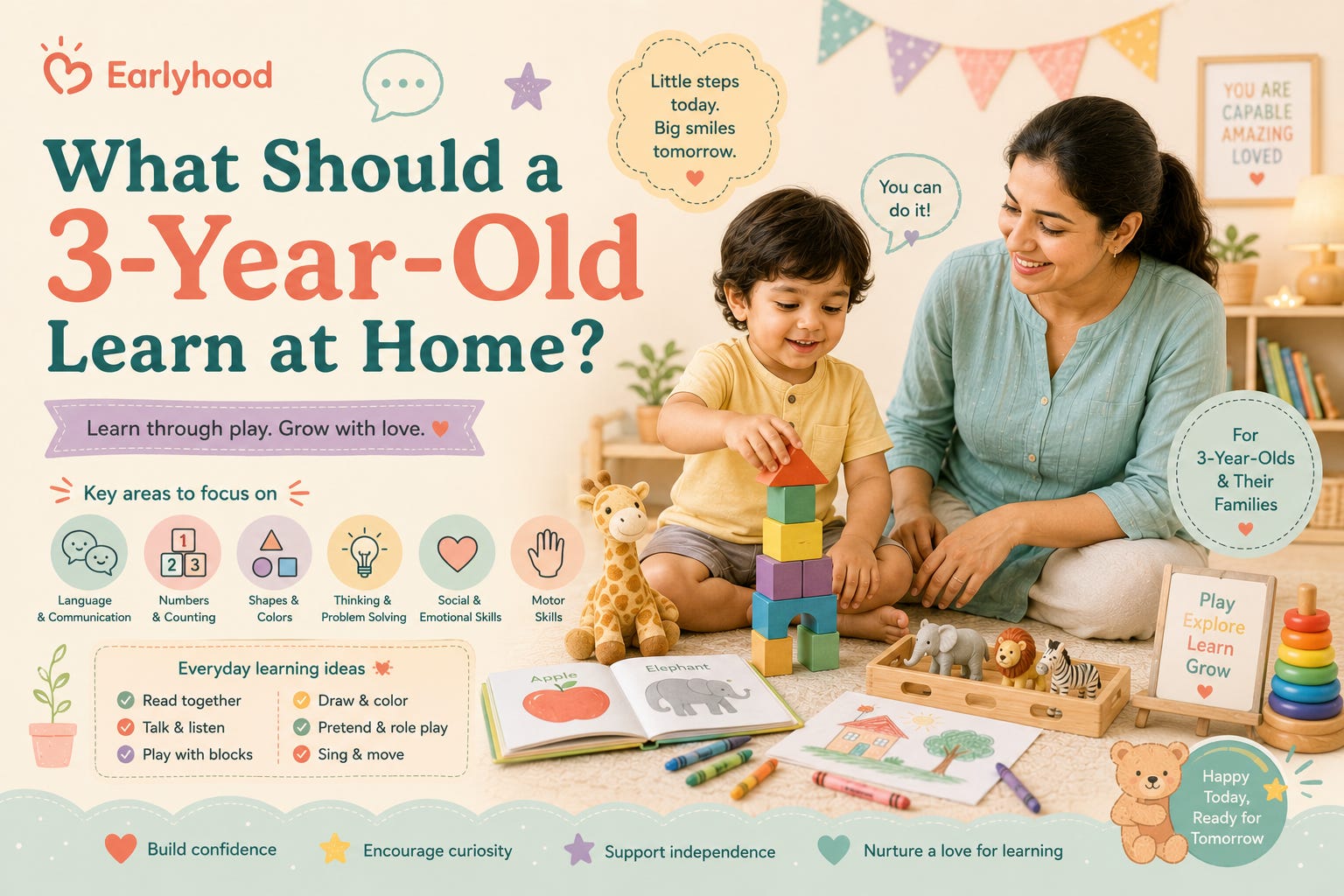
At 3 years old, children are full of curiosity.
They ask questions, copy adults, repeat words, run around, sing, pretend, build, draw, and explore everything around them. This is a beautiful age because children are no longer babies, but they are also not ready for heavy academic pressure.
Many parents wonder:
“What should my 3-year-old know?”
“Should my child start writing?”
“Should I teach alphabets and numbers?”
“Is my child learning enough at home?”
The answer is simple: a 3-year-old should learn through real experiences, not pressure.
At this age, learning should feel like play, not schoolwork. The goal is not to make the child perfect at reading, writing, or counting. The goal is to build language, confidence, attention, independence, imagination, movement, and love for learning.
1. Language and Talking Skills
One of the most important things a 3-year-old learns is language.
Children learn words by hearing people talk. So the best learning activity at home is simple conversation.
Talk during daily routines:
“This is your red cup.”
“We are washing hands.”
“The water is warm.”
“Let’s put the toys in the basket.”
“You are wearing blue shoes today.”
Ask simple questions:
“What did you make?”
“Where is the ball?”
“Who is in the story?”
“What should we do next?”
Do not worry about making every sentence perfect. The more your child hears meaningful language, the more they understand and speak.
Stories, rhymes, songs, pretend play, and daily conversations all support language growth.
2. Listening and Following Simple Instructions
At 3, children are learning how to listen and follow directions.
Start with one-step instructions:
“Bring the book.”
“Put the spoon here.”
“Close the box.”
“Wash your hands.”
“Give this to papa.”
Slowly move to two-step instructions:
“Pick up the ball and put it in the basket.”
“Take your shoes and sit near the door.”
Keep your voice calm and instructions short.
This builds attention, memory, understanding, and cooperation.
3. Colours, Shapes, and Everyday Concepts
A 3-year-old can start learning colours, shapes, sizes, and simple comparisons naturally.
Use daily life instead of only worksheets.
Point out:
Red apple
Round plate
Big spoon
Small cup
Long pencil
Soft pillow
Heavy bag
Empty bottle
Full glass
While playing, ask:
“Can you find something yellow?”
“Which block is bigger?”
“Is this ball round?”
“Can we sort these by colour?”
These simple moments build early thinking and observation skills.
4. Early Numbers and Counting
At this age, children do not need formal math lessons.
They can begin with playful counting.
Count stairs while climbing.
Count spoons on the table.
Count toys while cleaning.
Count fingers during songs.
Count fruits in a bowl.
You can say:
“Let’s count three bananas.”
“One, two, three.”
“You have two cars.”
“Give me one block.”
The goal is to make numbers familiar, not stressful.
Some children may count to 10, some may skip numbers, and some may only understand small quantities. That is okay. Repetition through play helps.
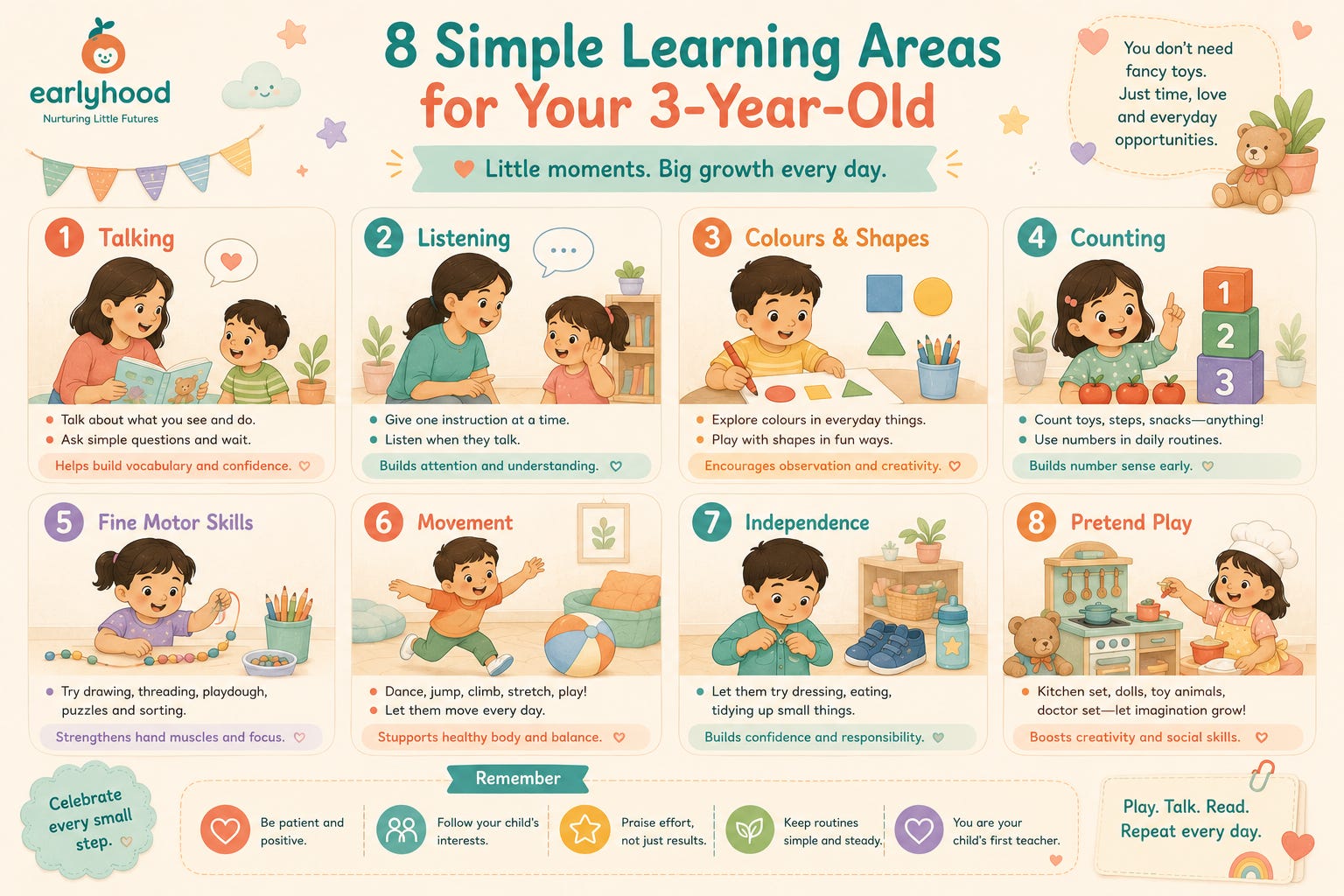
5. Fine Motor Skills
Fine motor skills are small hand movements that later help with writing, drawing, buttoning clothes, eating, and self-care.
Useful activities include:
Clay play
Tearing paper
Sticking stickers
Scribbling with crayons
Building blocks
Threading big beads
Opening and closing boxes
Using a spoon
Turning book pages
Sorting small safe objects
Do not rush writing.
Before writing letters, children need strong fingers, hand control, and confidence. Scribbling, colouring, clay, and blocks are all preparation for writing.
6. Gross Motor Skills
A 3-year-old also needs big body movement.
Running, jumping, climbing, balancing, dancing, throwing a ball, kicking a ball, and crawling all support physical development.
At home, you can create simple movement games:
Jump like a frog
Walk like an elephant
Tiptoe like a cat
Freeze like a statue
Throw soft balls into a basket
Walk on a line made with tape
Movement helps children use energy, improve coordination, and build confidence.
7. Independence in Daily Routines
Learning is not only academic.
At 3, children should slowly start doing small things independently.
They can learn to:
Wash hands
Put toys in a basket
Wear simple shoes
Drink from a cup
Eat with a spoon
Put clothes in the laundry basket
Choose between two outfits
Help set the table
Keep books back after reading
These small tasks build responsibility, confidence, and self-help skills.
Parents should not expect perfection. The goal is participation.
8. Social and Emotional Skills
Three-year-olds are still learning how to manage emotions.
They may cry easily, say no, grab toys, or struggle to share. This is common because emotional control is still developing.
At home, teach feeling words:
“You are angry.”
“You feel sad.”
“You are excited.”
“You wanted that toy.”
“It is hard to wait.”
Also teach simple social language:
“Please.”
“Thank you.”
“Can I have it?”
“My turn.”
“Sorry.”
“Help me.”
These small words help children express themselves better.
9. Imagination and Pretend Play
Pretend play is very important at age 3.
Children may pretend to cook, talk on the phone, teach a class, drive a bus, run a shop, or take care of a doll.
This builds language, creativity, memory, problem-solving, and emotional understanding.
You can support pretend play with simple objects:
Spoons
Cups
Toy animals
Old bags
Scarves
Boxes
Dolls
Blocks
Paper tickets
Small notebooks
Let your child lead the story.
Earlyhood Tip
For a 3-year-old, the best learning plan is simple:
Talk daily. Read daily. Play daily. Move daily. Let your child help daily.
You do not need expensive toys or long study time. Everyday moments are powerful learning opportunities.
Final Thought
A 3-year-old does not need pressure to perform.
They need a warm environment where they can speak, play, move, imagine, ask questions, make mistakes, and try again.
Learning at this age should feel joyful.
If your child is talking more, exploring more, pretending more, helping more, listening better, moving confidently, and showing curiosity, learning is happening.
Because at 3, the strongest foundation is not built through worksheets.
It is built through connection, play, stories, routines, and love.
Join the Earlyhood Parent Community for trusted guidance on learning, parenting, health, preschool, activities, and storytime for children aged 0–8.