



Children are naturally made to move.
They run, jump, climb, balance, throw, kick, crawl, chase, collect leaves, splash in puddles, watch ants, and ask endless questions about the world. For young children, outdoor play is not just “timepass.” It is an important part of healthy growth.
In today’s lifestyle, many children spend more time indoors than before. Apartments, busy roads, screen time, safety worries, school routines, and lack of open spaces can reduce daily outdoor play.
But children aged 0–8 need regular movement, fresh air, sunlight, nature, and free play.
The CDC says children aged 3–5 should be physically active throughout the day, and caregivers should encourage active play like jumping or riding a tricycle. WHO also recommends that young children should sit less, have more active play, and get good-quality sleep as part of a healthy 24-hour day.
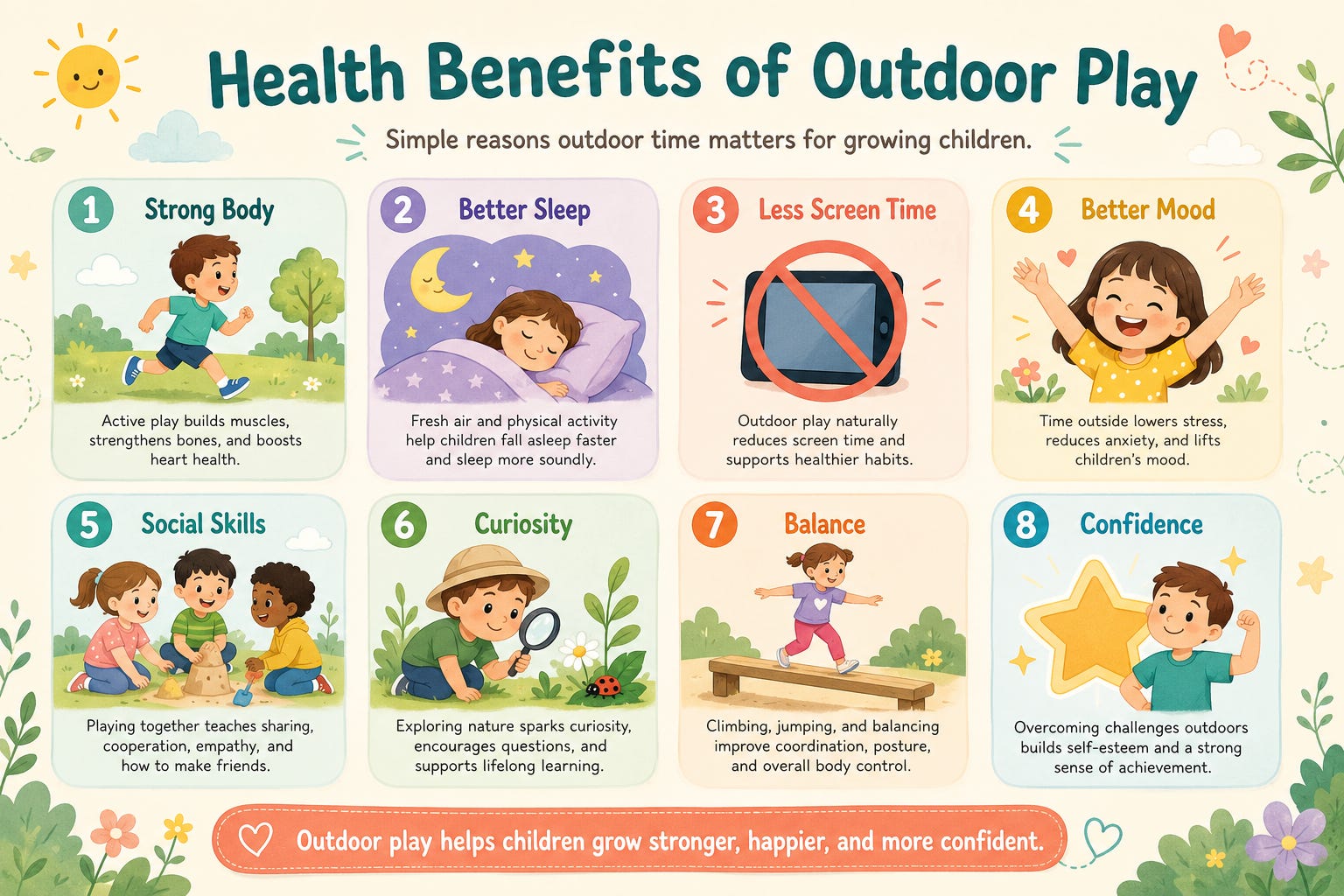
Outdoor play supports the whole child — body, brain, mood, sleep, social skills, and confidence.
Outdoor Play Builds Strong Bodies
Outdoor play gives children space to use their whole body.
When children run, climb, jump, cycle, play ball, or balance on a line, they build strength, stamina, coordination, and body control.
These movements support:
Leg strength
Arm strength
Balance
Flexibility
Coordination
Body awareness
Hand-eye coordination
Confidence in movement
Indoor play is useful too, but outdoor spaces allow bigger movement. A child can run faster, throw farther, climb higher, and explore more freely outside.
WHO notes that physical activity supports healthy growth, muscle development, bone health, and motor development in children and adolescents.
Outdoor Play Supports Better Sleep
Children who move well during the day often settle better at night.
Outdoor play helps children use physical energy. Running, jumping, climbing, cycling, and active games can make the body naturally ready for rest later.
Of course, outdoor play alone will not solve every sleep problem. Bedtime routine, screen time, food, naps, and family schedule also matter.
But daily physical activity is an important part of a healthy rhythm.
A child who spends the full day sitting indoors may feel restless in the evening. A child who has enough movement often has a better chance of feeling calm and ready for sleep.
Outdoor Play Reduces Screen Dependence
Many children ask for screens when they are bored.
Outdoor play gives them something real to do.
A park, terrace, garden, playground, walking path, or open space can offer many natural activities: running, cycling, ball play, sand play, leaf collecting, nature observation, pretend games, and simple movement challenges.
WHO’s guidance for young children focuses on replacing long sitting and screen-based sedentary time with more active play.
The goal is not to remove screens completely from every family. The goal is to make sure screens do not replace movement, sleep, social play, and real-world exploration.
Outdoor Play Builds Immunity and Health Habits
Outdoor play exposes children to fresh air, movement, sunlight, and natural surroundings.
It also helps children build health habits early.
A child who plays outside regularly learns:
My body needs movement.
Running feels good.
Fresh air feels refreshing.
Playing with friends is fun.
Nature is interesting.
I can climb, balance, and try.
These habits matter because children who grow up enjoying movement are more likely to see activity as a normal part of life.
Parents do not need to make outdoor play feel like exercise. For young children, play itself is the exercise.
Outdoor Play Improves Mood
Children often release emotions through movement.
After sitting for long hours, listening to instructions, or staying indoors, children may become cranky, restless, or irritable. Outdoor play gives them space to reset.
Running, jumping, climbing, digging, cycling, or playing chase can help children release energy and feel lighter.
Outdoor play can also support emotional confidence.
When a child learns to climb a small ladder, balance on a line, throw a ball, or ride a cycle, they feel proud.
That feeling says:
“I can do this.”
Small outdoor achievements build big confidence.
Outdoor Play Supports Social Skills
Outdoor play helps children interact with other children naturally.
In a playground, children learn many social skills:
Waiting for a turn
Sharing space
Asking to join
Following simple game rules
Helping a friend
Handling small conflicts
Using words
Solving problems
Learning from older children
Comforting younger children
These skills are hard to teach only through instructions.
Children learn them better through real play.
For example, when two children want the same swing, they slowly learn waiting, negotiating, or asking an adult for help. When children play catch, they learn turn-taking. When they build with sand, they learn teamwork.
Outdoor play gives children real-life practice in social behaviour.
Outdoor Play Builds Curiosity
Nature is one of the best teachers.
A child outdoors may notice:
Why are ants walking in a line?
Why do leaves fall?
Why is the sky changing colour?
Why is this stone smooth?
Why is the soil wet?
Why do birds fly away?
Why is my shadow long?
These questions build observation, language, thinking, and curiosity.
Parents do not need to answer everything perfectly. Sometimes the best response is:
“Let’s observe.”
“What do you think?”
“Shall we check again tomorrow?”
“Let’s find more leaves like this.”
Outdoor play turns the world into a learning space.
Simple Outdoor Play Ideas
Outdoor play does not need expensive equipment.
Try:
Morning park walk
Leaf collecting
Bubble play
Ball throwing
Cycling or tricycle riding
Running races
Hopscotch
Nature treasure hunt
Sand play
Watering plants
Balancing on a line
Chalk drawing
Climbing playground equipment safely
Kicking a soft ball
Walking barefoot on safe grass
Watching birds or clouds
Even 20–30 minutes of outdoor play can feel refreshing for young children.
Outdoor Play by Age
Ages 0–2:
Fresh air walks, floor play on a mat, watching trees, crawling safely, ball rolling, gentle nature observation.
Ages 2–4:
Running, jumping, ball play, tricycle, sand play, bubbles, simple climbing, nature walks, collecting leaves.
Ages 4–6:
Cycling, playground play, hopscotch, throwing and catching, obstacle games, group play, nature treasure hunts.
Ages 6–8:
Football, cricket basics, badminton, cycling, skating, longer walks, team games, gardening, simple outdoor challenges.
Always choose safe, age-appropriate activities.
Safety Matters Too
Outdoor play should be free, but not careless.
Parents should check:
Is the space safe?
Is there traffic nearby?
Is playground equipment broken?
Is the surface too slippery?
Are there sharp objects?
Is the child hydrated?
Is the weather too hot?
Is adult supervision needed?
Is the child wearing comfortable footwear?
For very young children, close supervision is important.
Also teach simple safety rules:
Stay where I can see you.
Ask before going far.
Wait before crossing.
Slide one by one.
Do not push.
Drink water.
Come when I call.
Outdoor play is best when children feel free and parents feel safe.
What if There Is No Park Nearby?
Many families do not have easy access to large parks.
That is okay.
Outdoor play can still happen in small ways:
Apartment courtyard
Terrace play
Building walkway
Nearby lane with supervision
School playground
Weekend park visit
Grandparent’s garden
Balcony gardening
Short evening walk
Community play area
Even small outdoor routines help.
The important thing is consistency.
Earlyhood Tip
Use this simple rule:
One outdoor movement break every day.
It can be a park visit, terrace play, cycling, ball play, or a short walk.
Do not wait for a perfect weekend plan. Daily small movement is more useful than rare big outings.
Final Thought
Outdoor play is not extra.
It is part of healthy childhood.
It helps children build stronger bodies, better movement, calmer moods, deeper sleep routines, social confidence, curiosity, and real-world learning.
A child does not need a perfect playground every day.
They need space to move, explore, observe, and play.
So open the door when possible. Take the child outside. Let them run, jump, climb, look, ask, laugh, and discover.
Because childhood grows better with sunlight, movement, fresh air, and freedom to play.
Join the Earlyhood Parent Community for trusted guidance on learning, parenting, health, preschool, activities, and storytime for children aged 0–8.