


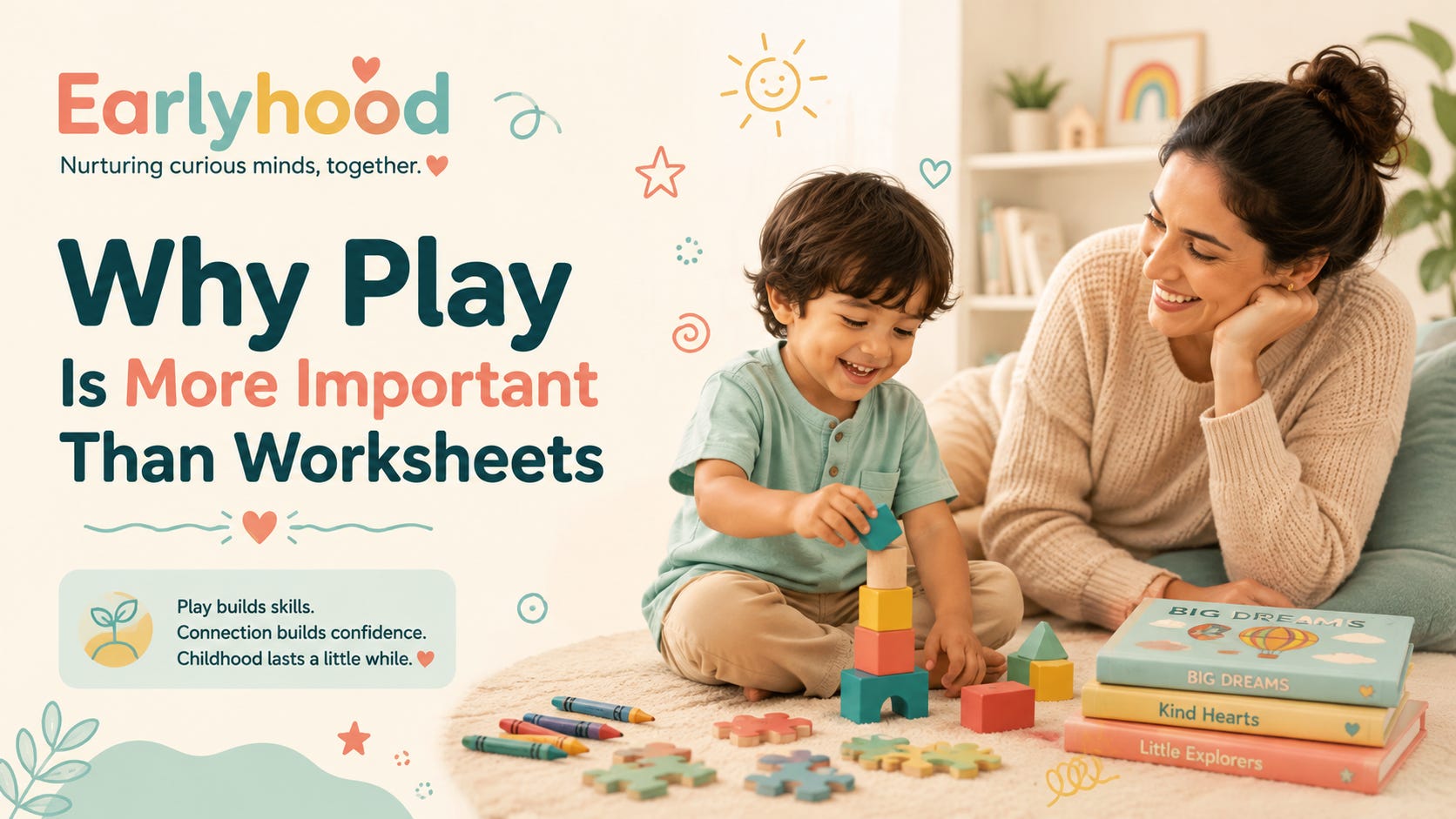
In early childhood, learning does not always look like sitting at a table with a pencil.
Sometimes, learning looks like stacking blocks.
Sometimes, it looks like pretending a spoon is a microphone.
Sometimes, it looks like drawing circles, mixing colors, building a tower, singing loudly, or asking the same question again and again.
Many parents worry when their child is not writing enough or completing enough worksheets. This worry is understandable, especially when school readiness and preschool expectations create pressure. But for children aged 0–8, real learning begins much before formal writing.
In the early years, play is not a break from learning. Play is learning.
Why Play Matters
Children learn through their senses, movement, imagination, and everyday experiences.
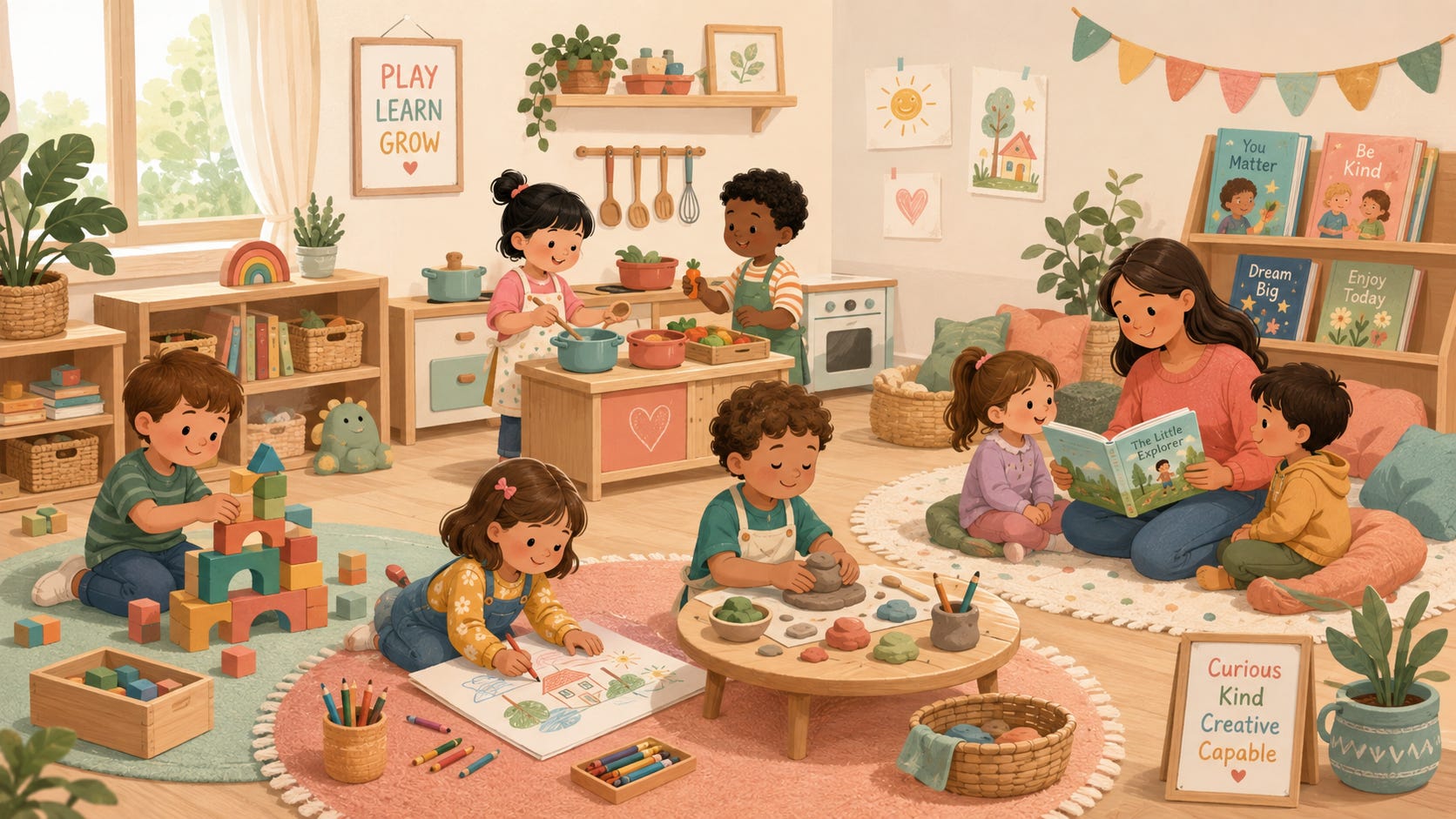
When a child plays with blocks, they are learning balance, size, shape, patience, planning, and problem-solving. When a child pretends to run a shop, they are learning language, memory, counting, confidence, and social behaviour. When a child draws or plays with clay, they are building fine motor skills that later support writing.
Play gives children the freedom to explore without fear of being wrong.
This is very important because young children learn best when they feel safe, curious, and interested. If learning becomes too much about right answers too early, children may begin to feel pressure instead of joy.
Why Worksheets Are Not Enough
Worksheets can be useful, but they should not become the main way children learn in early childhood.
A worksheet may help a child trace a letter, match objects, or circle the correct answer. But it may not always help the child deeply understand, question, imagine, speak, move, or solve problems independently.
When worksheets are introduced too early or used too much, children may learn to complete tasks without truly enjoying learning. They may start waiting for instructions instead of exploring ideas on their own.
Early learning should first build curiosity. Structured practice can come later.
A child who is allowed to play, experiment, and ask questions is building a stronger foundation for future learning.
What Children Learn Through Play
Play supports many areas of development at the same time.
Language: Children talk more during pretend play, storytelling, singing, and role play. A simple “doctor game” can introduce words like fever, medicine, patient, rest, and check-up.
Thinking skills: Puzzles, sorting games, blocks, and pretend situations help children solve problems and understand cause and effect.
Social skills: When children play together, they learn to wait, share, negotiate, listen, and handle small conflicts.
Emotional strength: Through play, children express fear, joy, anger, care, and confidence. A child may make a teddy cry and then comfort it. That is emotional learning.
Physical development: Running, jumping, climbing, drawing, cutting, sticking, and clay play support body control, hand strength, coordination, and confidence.
This is why play-based learning feels simple, but its impact is deep.
Simple Play Ideas Parents Can Try
Parents do not need expensive toys. Everyday activities can become powerful learning moments.
1. Block play
Give your child blocks, boxes, or safe household objects. Ask, “Can we build a tall tower?” or “What happens if this block goes on top?”
2. Pretend play
Let your child play kitchen, doctor, teacher, shopkeeper, bus driver, or restaurant. Join the game and ask simple questions.
3. Sorting games
Ask your child to sort toys, spoons, buttons, leaves, or clothes by colour, size, shape, or type. This builds early math and observation skills.
4. Art and clay
Drawing, coloring, tearing paper, sticking, painting, and clay play improve hand control and creativity. Don’t focus only on the final output. Let the child enjoy the process.
5. Story-based play
Read a short story and then act it out. If the story has animals, let your child become the lion, rabbit, bird, or elephant. This builds memory, language, and imagination.
What Parents Should Remember
Not every learning activity needs to look academic.
A child may not write the letter “A” perfectly today, but they may have learned how to hold a crayon, name a colour, complete a puzzle, ask a question, share a toy, or explain a pretend story.
These are all important learning steps.
Instead of asking only, “How many pages did my child finish?” parents can ask:
What did my child explore today?
What new word did my child use?
What problem did my child solve?
What story did my child imagine?
What made my child curious?
These questions reveal the real learning happening in the early years.
Earlyhood Tip
Use worksheets as a small part of learning, not the whole learning experience.
For young children, the better balance is:
More play. More conversation. More stories. More movement. Less pressure.
Final Thought
Children are not designed to learn only by sitting still.
They learn by touching, moving, pretending, building, singing, drawing, running, listening, and exploring.
Worksheets may show what a child remembers, but play shows how a child thinks, feels, speaks, creates, and grows.
In early childhood, play is not a distraction from learning.
Play is the foundation of learning.
Join the Earlyhood Parent Community for trusted guidance on learning, parenting, health, preschool, activities, and story time for children aged 0–8.