


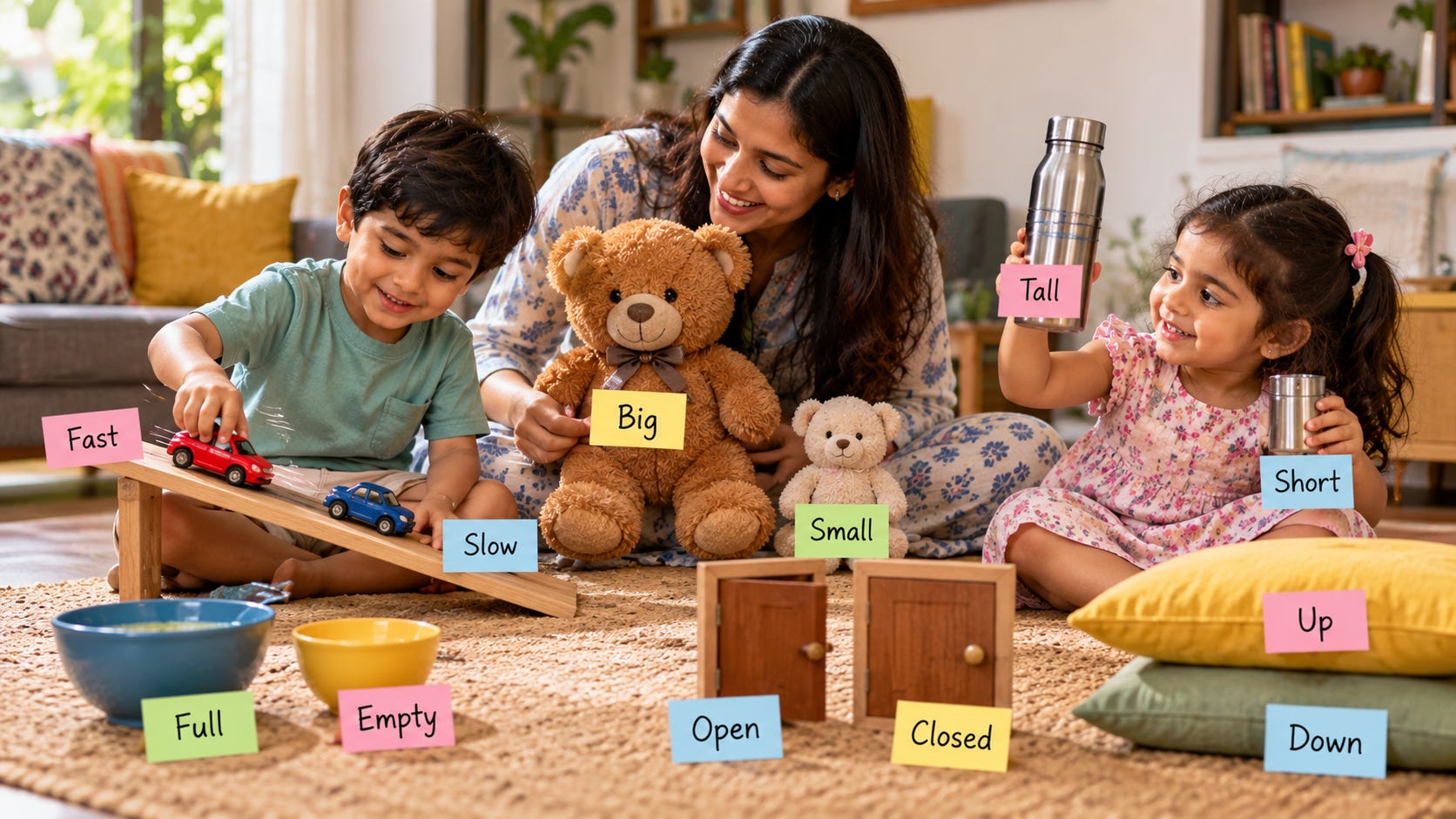
Big and small.
Hot and cold.
Fast and slow.
Up and down.
Learning opposites helps children build vocabulary while understanding how things relate to one another.
Teach through real life
You don’t need flashcards.
Try:
Big and small
Compare two spoons or two toys.
Fast and slow
Walk quickly, then slowly.
Loud and quiet
Clap loudly, then softly.
Up and down
Move a toy car up and down a ramp.
CDC suggests simple opposite games for three-year-olds, such as demonstrating small/big and fast/slow.
Let your child demonstrate
Ask:
“Can you show me something tall?”
“Can you walk very slowly?”
“What is the opposite of open?”
Children often remember ideas better when they can move, touch and experience them.
Don’t turn it into a test
If your child gets an answer wrong, demonstrate the difference again.
Learning happens through repetition.
💚 Earlyhood Parent Tip
Use your home as the activity.
Full/empty cups, long/short pencils and open/closed doors can teach concepts without another worksheet.