


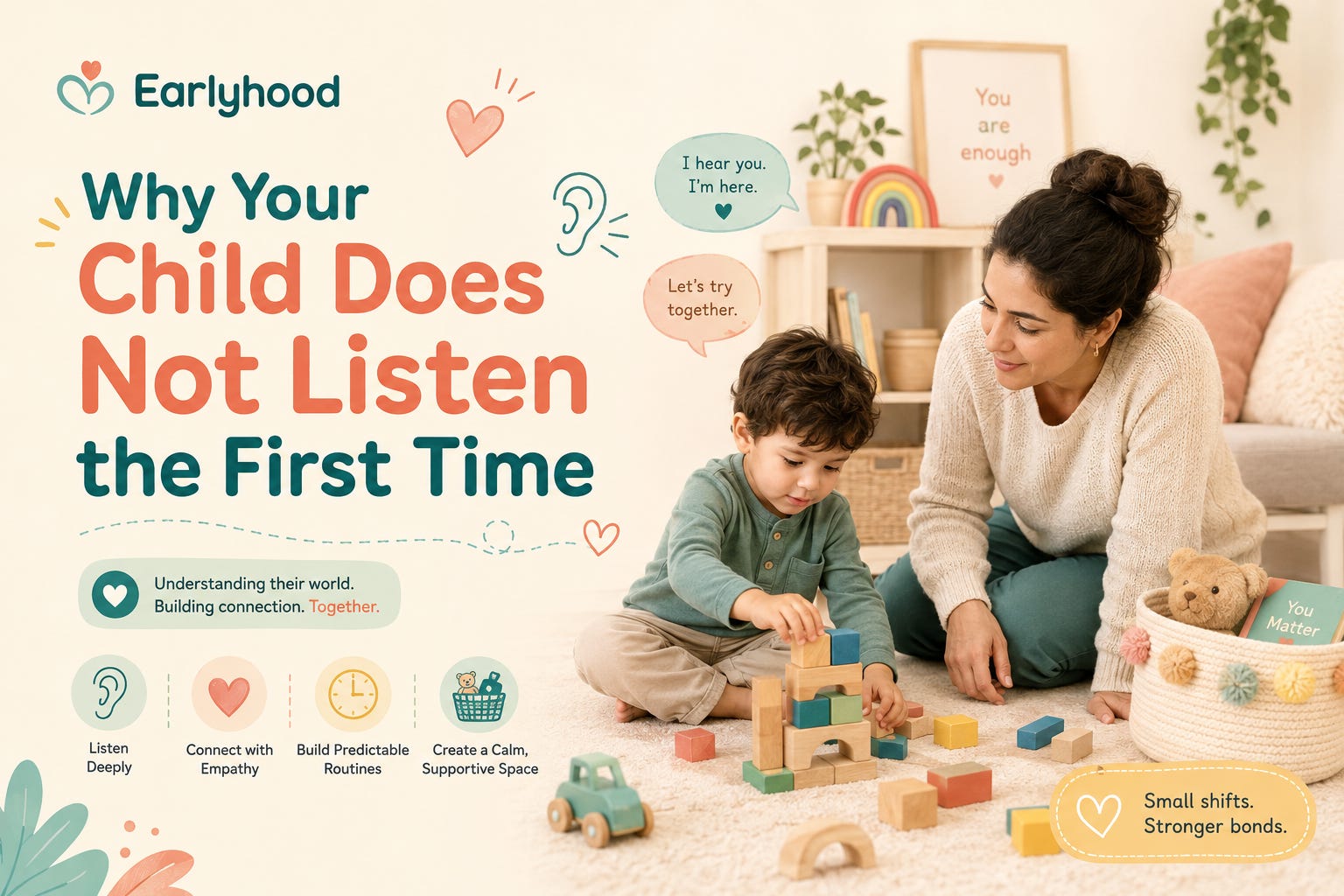
Many parents say this almost every day:
“My child does not listen.”
You may ask your child to put toys away, come for dinner, brush teeth, stop jumping on the sofa, wear shoes, or get ready for school. But your child continues playing, ignores you, says “no,” runs away, or listens only after you repeat the same thing many times.
This can feel frustrating.
But in early childhood, not listening is not always intentional disobedience. Many times, children are deeply involved in what they are doing, still developing self-control, struggling with transitions, or simply not understanding the instruction clearly.
Children aged 0–8 are still learning how to listen, pause, shift attention, follow steps, and manage emotions. So instead of thinking, “My child is doing this on purpose,” it helps to ask, “What is making listening difficult right now?”
Why Children Don’t Listen Immediately
Young children live in the present moment.
If they are building blocks, pretending with toys, watching something interesting, or running around, their brain is focused on that activity. When a parent suddenly says, “Come now,” the child may not shift immediately.
Listening requires many small skills:
Hearing the instruction
Understanding it
Stopping the current activity
Managing disappointment
Remembering what to do next
Actually doing it
For adults, this feels simple. For children, it takes practice.
Sometimes children also ignore instructions because they hear too many commands in a day. “Don’t run.” “Sit properly.” “Eat fast.” “Stop touching.” “Come here.” “Wear this.” “Don’t do that.”
When there are too many instructions, children may slowly stop responding to all of them.
First, Get Their Attention
Before giving an instruction, make sure your child is actually listening.
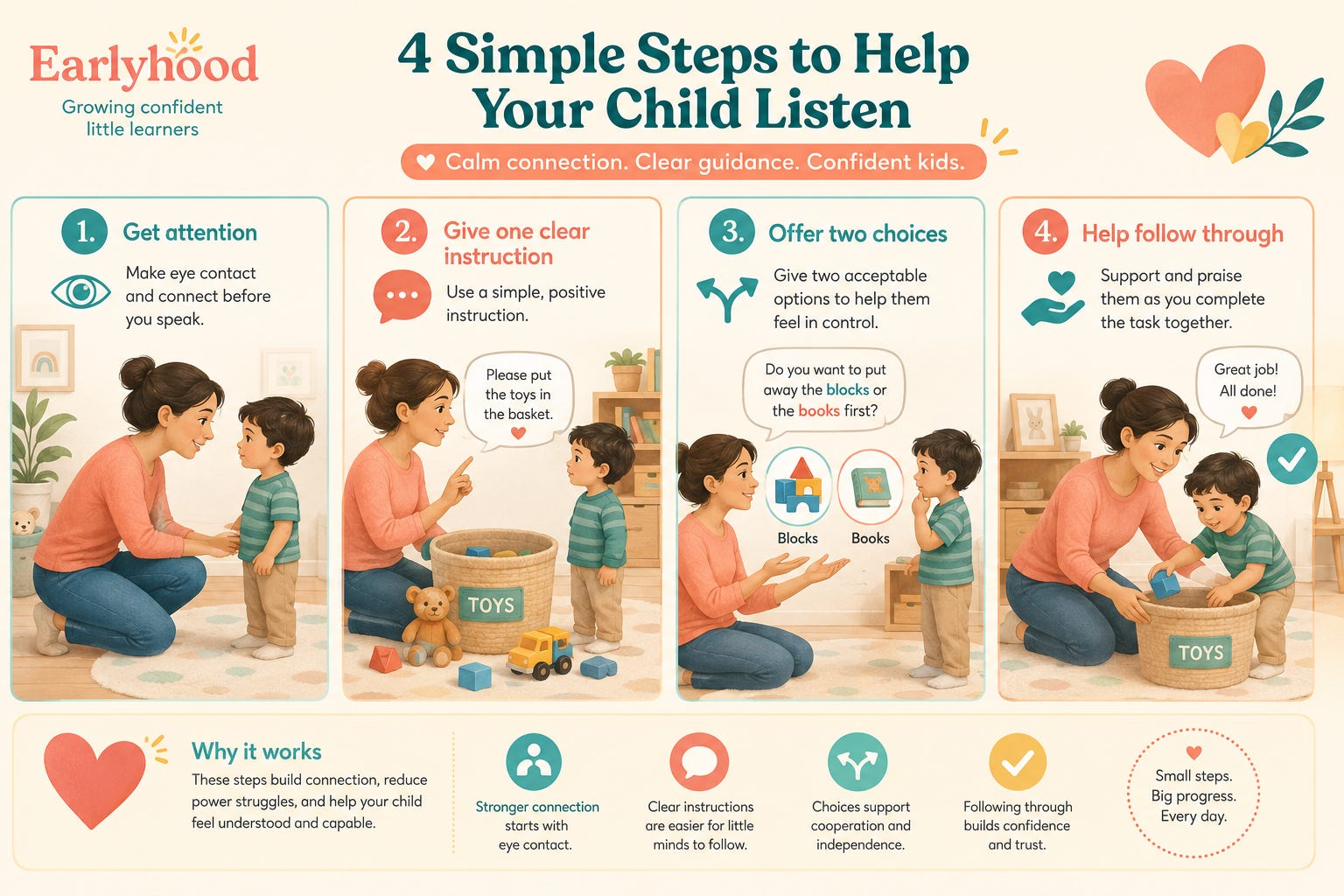
Instead of shouting from another room, go closer. Say your child’s name gently. Come down to their level. Make eye contact if they are comfortable. Touch their shoulder softly if needed.
Then speak.
For example:
“Aarav, look at me. It is time to keep the blocks away.”
This works better than saying the same line five times from far away.
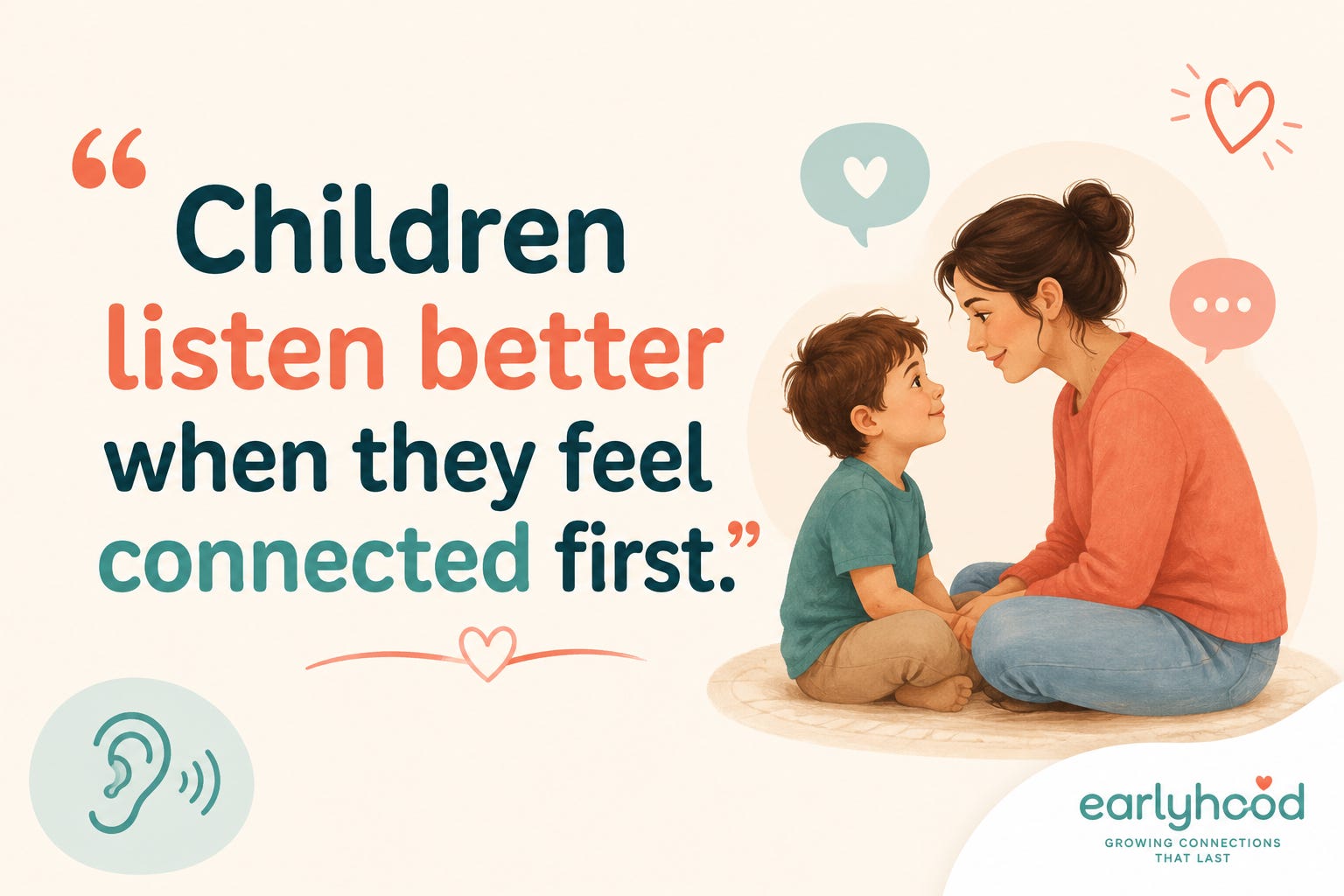
Children listen better when they feel connected first.
Use Simple Instructions
Long instructions can confuse young children.
Instead of saying:
“Why are all your toys lying here? I told you so many times to keep everything properly. Now clean this room quickly because we have to go out.”
Say:
“Please put the blocks in the basket.”
One instruction at a time is easier to follow.
For younger children, use short and clear lines:
“Shoes on.”
“Come to the table.”
“Hands to yourself.”
“Books in the basket.”
“Brush first, then story.”
If the task has many steps, break it down.
Instead of “Get ready,” say:
“First wear your socks.”
“Now wear your shoes.”
“Now take your bag.”
Give Transition Warnings
Children often resist when they are asked to stop something suddenly.
If your child is playing and you suddenly say, “Stop now, we are leaving,” the child may feel upset. But if you prepare them, cooperation becomes easier.
Use warnings:
“Five more minutes, then dinner.”
“Two more slides, then we go home.”
“One last story, then sleep.”
“After this puzzle, we will brush teeth.”
This helps the child’s mind shift from one activity to another.
You can also use visual or simple cues:
“When the timer rings, we clean up.”
“When this song ends, we wear shoes.”
“After three jumps, we sit for dinner.”
Children listen better when they know what is coming next.
Offer Limited Choices
Children like to feel some control.
Instead of giving open-ended options or forcing everything, offer two acceptable choices.
For example:
“Do you want to wear the red shoes or blue shoes?”
“Do you want to brush first or change clothes first?”
“Do you want to walk to the room or should I carry you?”
“Do you want to keep blocks or books first?”
Both choices lead to the same goal, but the child feels involved.
This reduces power struggles.
Avoid Repeating Too Many Times
When parents repeat instructions ten times, children learn that they do not need to respond the first time.
Try this:
Say the instruction clearly once.
Wait a few seconds.
Repeat calmly once more.
Then help the child follow through.
For example:
“It is time to keep the toys in the basket.”
If the child does not move, go near and say:
“I will help you start. Put this car in first.”
This teaches action, not just listening.
Praise Listening When It Happens
Parents often notice when children don’t listen, but forget to notice when they do.
Catch small moments of cooperation.
Say:
“Thank you for coming when I called.”
“You kept your shoes nicely.”
“I liked how you listened the first time.”
“You stopped running when I asked. That was helpful.”
Children repeat behaviour that gets positive attention.
Praise should be simple and specific.
Check the Real Reason
Sometimes children don’t listen because something else is happening.
They may be tired.
Hungry.
Overstimulated.
Too excited.
Feeling ignored.
Wanting connection.
Unable to do the task alone.
Confused by the instruction.
For example, a child may not wear shoes because they cannot put them on properly. A child may not come for dinner because they are too tired. A child may not clean toys because the mess feels too big.
When parents understand the reason, they can support better.
Earlyhood Tip
Use this simple formula:
Connect. Say clearly. Give time. Follow through.
First connect with your child. Then give a short instruction. Allow a few seconds to process. Then gently guide the child into action.
Listening is not built through shouting. It is built through consistency.
Final Thought
Your child is not always ignoring you on purpose.
Sometimes they are learning how to shift attention, manage feelings, understand instructions, and cooperate with routines.
This takes time.
A calm parent, simple words, predictable routines, and gentle follow-through can make a big difference.
Instead of asking, “Why won’t my child listen?” try asking:
“How can I make it easier for my child to listen?”
That small shift can change the whole parenting moment.
Join the Earlyhood Parent Community for trusted guidance on learning, parenting, health, preschool, activities, and storytime for children aged 0–8.